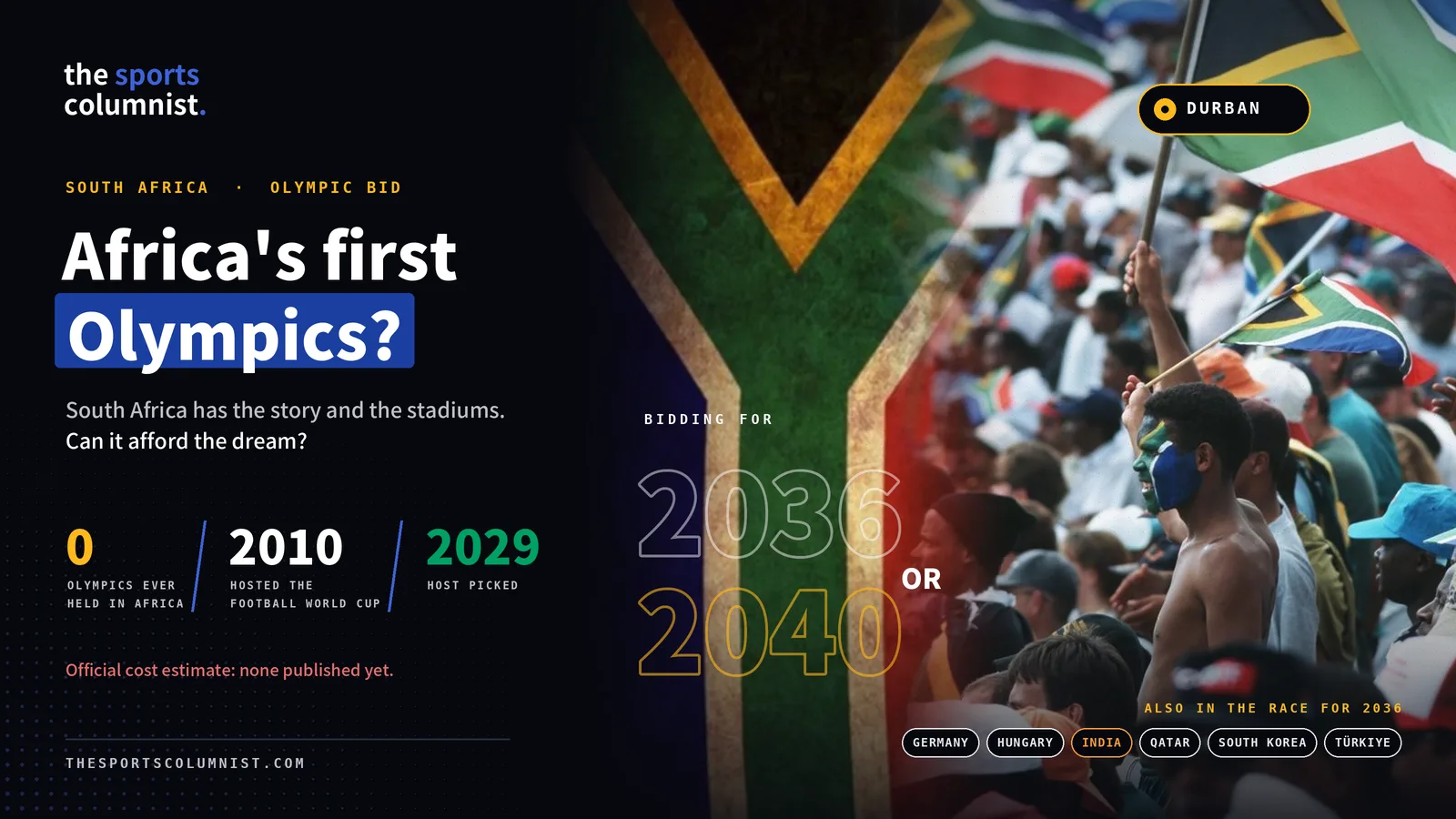
No Olympic Games has ever been held in Africa. South Africa wants to change that. This week, the country named Durban as the heart of its South Africa Olympic bid for 2036 or 2040. It’s a bold, emotional pitch, but it raises the hardest question in sport: can a country turn the world’s most expensive event into a good investment?
What happened
The South African Sports Confederation and Olympic Committee (SASCOC) unveiled the coastal city of Durban as its preferred host to bring the Olympics to Africa for the first time. South Africa will bid for either the 2036 or 2040 Games, and the bid has official support: the South African government has backed the bid after the cabinet approved it.
Durban won’t go it alone. SASCOC’s acting president, Lwandile Simelane, said Durban would be the main candidate city for South Africa’s bid, but it would likely be a “multi-city bid” that would propose a number of events to be held in other cities. The three largest cities in South Africa all expressed interest — Johannesburg, Cape Town and Durban.
The timeline
This is a long race. SASCOC will deliver presentations to the International Olympic Committee’s Future Host Commission in November, with feasibility reviews concluding in March 2027 and a final host selection in 2029.
A crowded field, including India
South Africa won’t be alone. The IOC has said Germany, Hungary, India, Qatar, South Korea, South Africa and Türkiye were in “continuous dialogue with a stated interest in hosting the 2036 Olympic Games.” nbcsports
That makes South Africa a direct rival to India, which is also building towards 2036, with the 2030 Commonwealth Games already heading to Ahmedabad.
The business case: why bid at all?
1. A powerful story. The “first Olympics in Africa” is the kind of narrative the IOC likes, and it’s South Africa’s strongest card.
2. A proven event host. South Africa staged the 2010 football World Cup, the first in Africa, and much of that infrastructure still stands. Reports suggest Durban’s Moses Mabhida Stadium would serve as the Olympic Stadium.
3. Using what already exists. Rather than building a huge new Olympic park, organizers intend to leverage existing facilities spread across South Africa’s major economic hubs. That’s exactly what the IOC now prefers, as it tries to make the Games cheaper and more sustainable.
4. Tourism and global attention. A home Olympics puts a country in front of billions of viewers, and can bring a long-term boost to tourism and investment, if it’s well run.
The risks
The cost is still unknown. Officials said they were not yet able to provide any estimates of the cost to South Africa of staging the Olympics if its bid were successful. Some local reports have described it as a R500 billion project, but no official figure has been published.
Durban has been here before. Durban won the bid to host the 2022 Commonwealth Games but the Commonwealth Games Federation stripped it of the rights in 2017, citing a failure to meet key obligations. The IOC will look closely at whether South Africa can deliver this time.
It’s not the first try. Africa’s biggest economy previously failed with a bid to stage the 2004 Games in Cape Town.
And the World Cup legacy is mixed. The 2010 tournament was a huge success on the day, but some of its stadiums have since struggled to fill seats and cover their costs. In our view, that’s the lesson the bid has to answer: an Olympics is only a good investment if the venues keep earning after the closing ceremony.
What it means for India
India and South Africa are chasing the same prize, with similar arguments: a “first” for a region, a growing economy, and the ambition to use sport to raise a country’s global profile. South Africa’s bid is a reminder that the IOC will judge not just the dream, but the delivery: costs, venues, governance, and what’s left behind afterwards. India’s own 2036 plans will face the same questions.
The question that matters
Is hosting the Olympics a smart investment for a developing economy, or an expensive way to make a statement? South Africa has the story, the stadiums and the history. Over the next three years, it will have to prove it also has the numbers.
At The Sports Columnist, we cover the deals, the money and the decisions behind sport. Every game has a second scoreboard, and the Olympics has the biggest one of all.
Sources: SASCOC announcement and IOC statements, October 2026.
Read more from The Sports Columnist
→ UK Olympic bid: why the North of England wants the Games
→ India will host the 2029 Weightlifting World Championships in Ahmedabad
→ ₹50 crore per event: can India turn sports events into an industry?
→ Get The Dugout, our free newsletter, every Monday

comments.
0 commentsNo comments yet. Be the first to join the conversation.