A football club plays perhaps once a week. A cricket franchise plays a few weeks a year. But open their Instagram, YouTube or X account on any day and something new is waiting: a training clip, a dressing-room video, a meme, a player answering fan questions.
That is not an accident. The match is still the product fans pay for. But the attention between matches has become a business of its own, and for sponsors it can be worth as much as the 90 minutes.
The content week
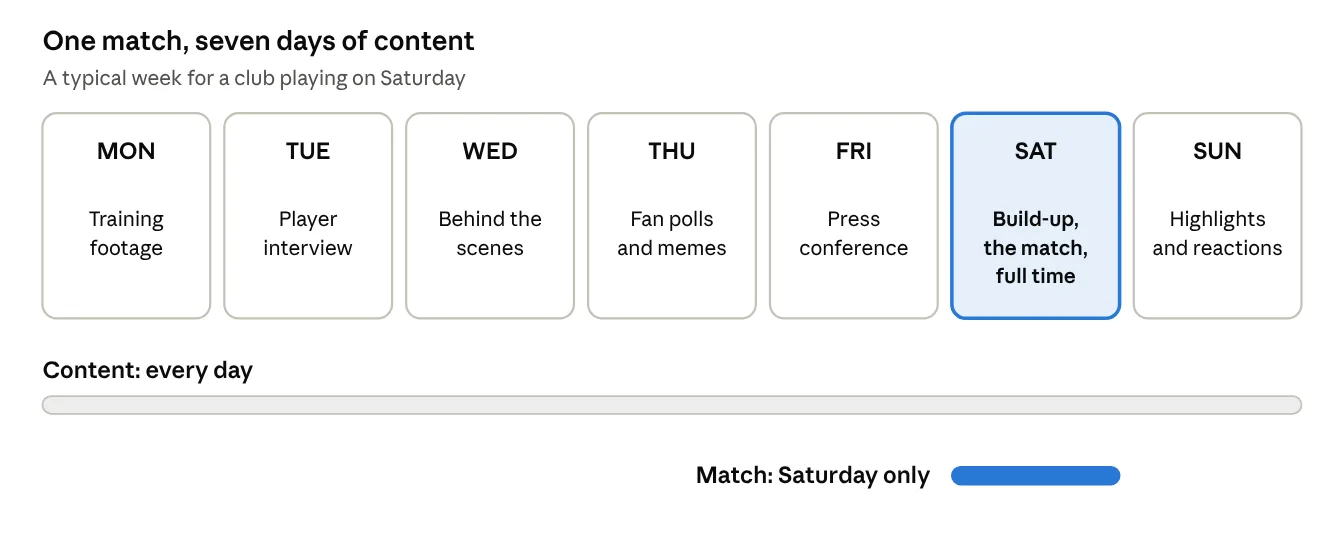
The match fills one day. Training clips, interviews, behind-the-scenes footage, fan polls, press conferences and highlights fill the other six. The exact mix varies by club, but the rhythm is the same: something new every day.
Why clubs became media companies
The match is scarce. There are only so many fixtures in a season, and the broadcast rights to them are usually sold by the league, not the club.
Attention between matches is not scarce, and the club owns it outright. Every follower on its own channels is an audience it reaches directly, without a broadcaster in the middle.
That changes what a club is selling. It is no longer just tickets and 90 minutes of TV time. It is a daily relationship with millions of fans, and that relationship can be measured, packaged and sold.
What the best clubs do differently
The clubs that lead here treat content as a department with its own people, budget and goals, not as a marketing afterthought. Look closely and the same habits show up again and again.
Players are the stars. The content people watch most is players being themselves: joking in training, reacting in the dressing room, answering fan questions.
Real emotion beats polish. Raw moments after a big win or a painful loss often outperform slick, scripted videos.
A dedicated team. Writers, editors, videographers and designers work on content full time, often travelling with the squad.
Every format, every platform. Short clips, long documentaries, memes and live shows, each made for where the fan is scrolling.
No off-season. The output keeps going between matches and between seasons, so fans never drift away.
The biggest lesson: a strong content operation can keep growing even in a season the team does not win. The audience is built for the club, not for the result.
What it means for sponsors
A sponsor used to buy a logo on a shirt and a board around the pitch. Today it also buys a place inside the club's content.
That looks like a branded training-drill series, a player Q&A "presented by" a partner, a behind-the-scenes documentary episode, or a matchday countdown with the sponsor's name on it.
This matters because content inventory is not limited by the fixture list. A club can only play so many matches, but it can create sponsored moments every day. And because the club owns its channels, it can show sponsors exactly how many people saw, watched and shared each one.
What it means for Indian sport
IPL franchises face the problem more sharply than most. The tournament runs for about two months, and for the rest of the year there are no matches to sell. Content is how a franchise stays in fans' lives, and in front of sponsors, for the other ten months.
The franchises that do this well put players at the centre, keep the raw emotion of the dressing room, and go to the platforms where their fans already are, including regional-language apps that reach fans far beyond the big cities.
For ISL clubs, Pro Kabaddi teams and smaller leagues, the lesson is even more useful. You do not need a giant broadcast deal to build an audience. You need a camera, access to your players and a daily habit of publishing.
The second scoreboard runs seven days a week
Fans still judge a club by its results. The business increasingly judges it by its audience.
The match is the moment. Content is the relationship. And the clubs that understand this are building something that keeps earning, win or lose.
Which club or team do you think does content best? Tell us, we read every reply.
Read more from The Sports Columnist
→ More opinion
→ Why a goalless draw is still a good day for the business of sport
→ Who is Indian sports business really for?
→ Get The Dugout, our free newsletter, every Monday