A goalless draw is the dullest result in sport. For the business of sport, it is often a perfectly good day. Here is why.
Ninety minutes. No goals. Fans walk out shrugging, and the highlights package barely fills a minute.
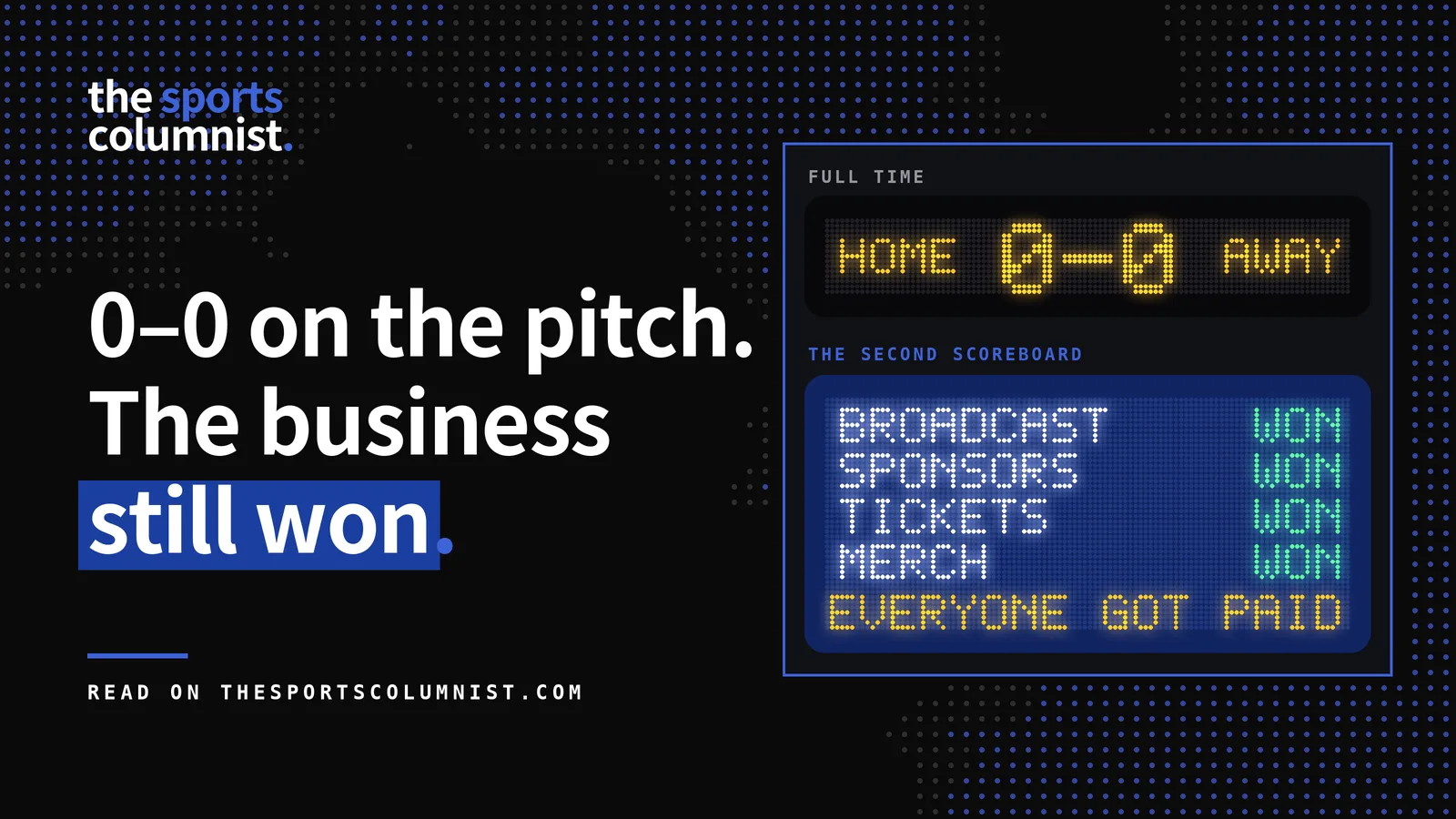
But look at a different scoreboard. The broadcaster sold its ad slots. The sponsors got their logos onto every replay. The tickets were paid for weeks ago. The shirts in the club shop sold anyway.
This is the second scoreboard every game has. It runs on contracts, rights and calendars, and most of it is settled long before the first whistle.
Broadcast: the money arrived years ago
The biggest line on the second scoreboard is media rights, and it is settled in auction rooms, not on the pitch. For the 2023–27 IPL cycle, the BCCI sold its media rights for ₹48,390 crore.
Those rights were split across buyers. Disney Star took Indian TV with a bid of ₹23,575 crore, and Viacom18 took Indian digital with ₹23,758 crore.
None of that money depends on whether a particular match is a classic or a dud. The broadcaster still sells its ad breaks, between overs, at innings change, during strategic timeouts. A tight finish helps ratings, but a one-sided game still fills the same inventory slots.
Sponsors: exposure is bought, not won
A shirt sponsor pays for visibility, and visibility does not need a goal. The logo is on the chest for every minute of the match, every replay and every photo, whatever the score.
The same goes for the boundary boards, the stumps, the LED hoardings and the title sponsor's name on the tournament itself. Those deals are signed for seasons, not single games.
Sponsorship is priced on expected reach across a whole season, so one flat game barely moves the value of the deal.
Tickets: paid for before kick-off
By the time a match starts, almost every rupee from the gate is already banked. Season tickets are sold before the season, and single-match tickets are bought days or weeks ahead.
The matchday money that is still in play, food, drinks and parking, depends on people turning up, not on the scoreline. Fans in the stands spend the same at half-time whether it is 0–0 or 3–2.
Merchandise: the shirt doesn't care about the score
Fans buy jerseys because of who they support, not because of one result. A replica shirt sells on identity, a star player's name and number, or a new kit launch.
A single dull match rarely changes that. What moves merchandise is the long arc: a title run, a superstar signing, a new season's design.
Where results do matter
This does not mean the score is irrelevant to the business. Results matter over a season, not a single game.
Prize money and standings. League positions and knockout runs decide prize pools and, in many competitions, a share of central revenue.
Relegation and qualification. In football, going down a division or missing out on a continental competition can cut a club's income sharply.
Playoff and knockout games. Extra matches mean extra ticket sales and extra broadcast inventory.
Long-term brand value. Winning teams attract more fans, which over time lifts the price of the next sponsorship and the next rights deal.
So one 0–0 changes almost nothing. A season of them changes a lot.
The second scoreboard
Fans watch one scoreboard: runs, wickets, goals. The industry watches another: rights fees, sponsor reach, gate receipts, shirt sales.
Most coverage reports only the first. At The Sports Columnist, we read the second, the deals, the decisions and the people behind them who never appear on camera.
So next time a match ends in a draw, ask a different question. Not who won, but who got paid.
Read more from The Sports Columnist
→ More opinion
→ Who is Indian sports business really for?
→ Virat Kohli joins LinkedIn. A big moment for India’s sportspreneurs.