This week, the Government of India honoured the athletes who brought back India's medals from the 2026 Asian Games. Prime Minister Narendra Modi met the contingent in New Delhi on 15 October and told them: "The youth of our nation look to you for more than just sports inspiration."
Alongside the athletes, JSW Sports was also recognised for its role as Team India's principal partner. That detail matters more than it might seem. Medals are won by athletes, but they are built by an ecosystem: coaches, sports science, facilities, funding and the companies willing to back sport long before the podium.
How India performed
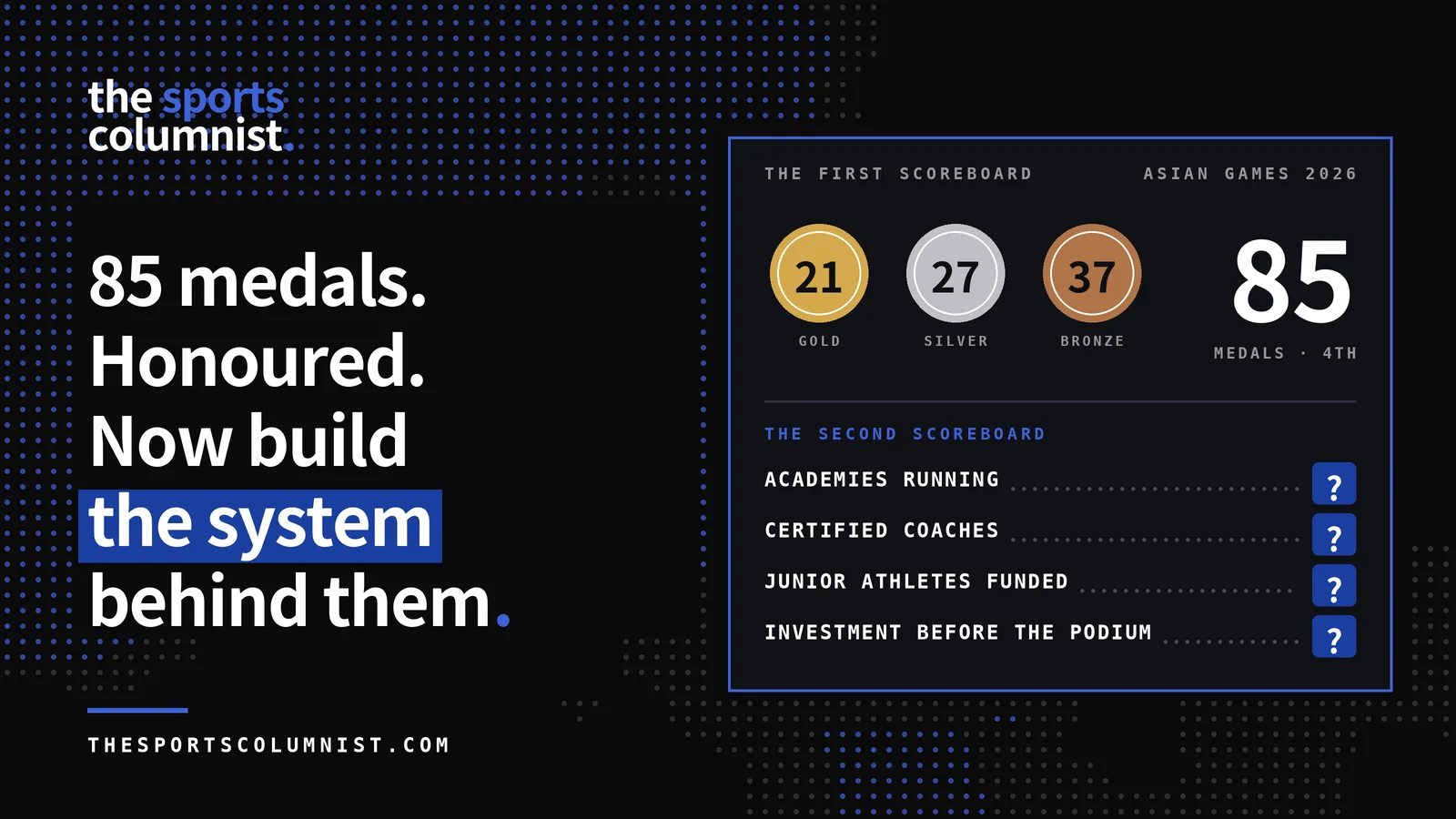
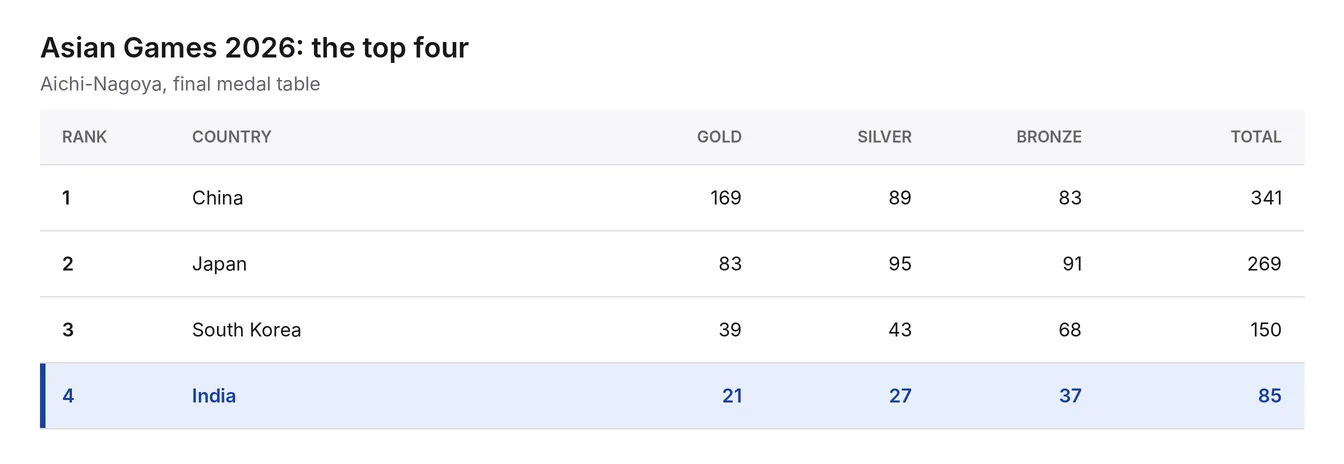
India finished fourth in Aichi-Nagoya with 85 medals: 21 gold, 27 silver and 37 bronze. That is India's second-best Asian Games haul, behind the 106 won at Hangzhou 2022.
There were real breakthroughs:
Hockey: both teams won gold. The men beat Malaysia 5-1 to qualify for Los Angeles 2028, and the women beat China 1-0 to end a 44-year wait.
Cricket and kabaddi: India won gold in men's and women's cricket, and in kabaddi.
Firsts: Kumkum Anil Mohod became the first Indian woman to win individual recurve archery gold, and Pranavi Urs the first Indian woman to win individual golf gold. India also won its first Asian Games weightlifting medal in 28 years and its first-ever mixed martial arts medal.
Wrestling and athletics: Aman Sehrawat and Sujeet Kalkal won freestyle golds, and the women's 4x400m relay team took gold.
The Services alone contributed a record 27 medals, according to the Defence Ministry.
JSW Sports: a sponsor that builds, not just brands
JSW's presence at these Games was visible on every podium. Its activewear brand, JSW Inspire, was the official sports performance and lifestyle partner for Team India at the 2026 Commonwealth Games and Asian Games, under a partnership with the Indian Olympic Association . JSW has dressed India's top athletes since the Tokyo Olympics, through Birmingham 2022, Hangzhou and Paris 2024.
IOA President PT Usha put it simply: "The JSW Group has been a strong pillar in supporting India's Olympic movement over the years."
The kit is the visible part. The deeper contribution is infrastructure:
Inspire Institute of Sport (IIS): a high-performance centre in Vijayanagar, Karnataka, opened in 2018. It spans 42 acres, with a combat hall, a strength and conditioning centre, a sports medicine centre, an athletics track and hostels.
Elite athletes: Neeraj Chopra and Vinesh Phogat are among those who have trained or rehabilitated there.
Recognition: the Sports Authority of India accredits IIS as a Khelo India centre for boxing and wrestling.
That is what makes the recognition meaningful. A logo on a jersey helps an athlete for two weeks. A training centre, coaches and sports science help them for a decade.
Where the ecosystem still has to grow
Celebrate the medals, but read the table honestly. China won 341 medals, Japan 269 and South Korea 150. India, a country of more than a billion people, won 85, and fewer than at Hangzhou.
The gap is not talent. It is depth. Four things stand out:
Too few podium sports. A large share of India's medals still come from a handful of disciplines. Asia's leaders win across dozens of sports, including swimming and gymnastics, where India rarely reaches a final.
A thin pipeline. Champions emerge from a wide base of school and club competition. In most Indian sports that base is still narrow, so success depends on a few exceptional individuals rather than a system that produces them.
Uneven access to high performance. World-class centres like IIS exist, but there are not enough of them. Many athletes still lack consistent access to coaches, physiotherapists, nutritionists and sports scientists.
Sponsorship that arrives late. Most brands back athletes once they are already winning. Far less money reaches the junior and development years, when it decides who keeps going and who quits.
The athletes delivered in Aichi-Nagoya. The system around them has to catch up.
Why an ecosystem matters for everyone in it
A strong sports ecosystem is not charity. Every stakeholder gets something back.
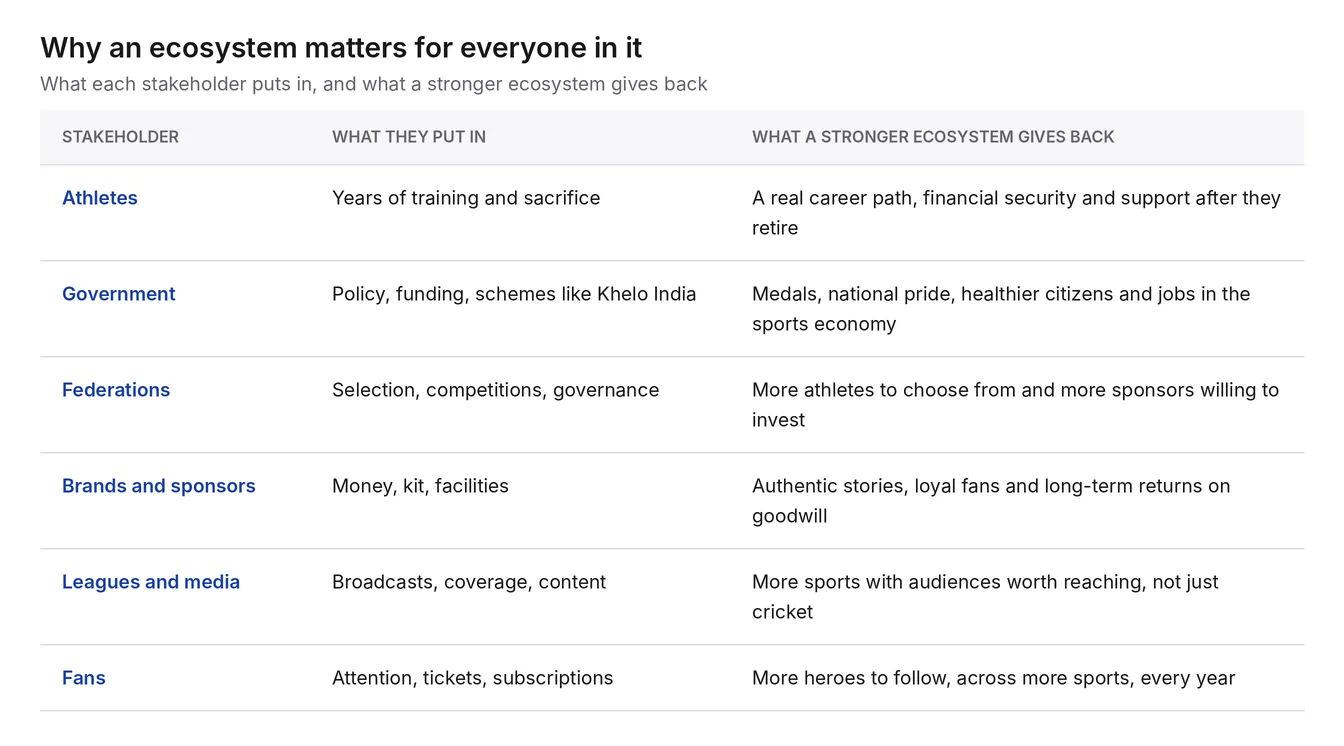
More heroes to follow, across more sports, every year
The link between them is simple. When more people play, more talent rises. More talent wins more medals. More medals attract more fans. More fans attract more sponsors and media. And more money flows back into coaching, facilities and the next generation.
That loop only turns if someone invests before the payoff. That is why partnerships like JSW's, which back infrastructure and athletes years before the podium, deserve the recognition they received this week.
The second scoreboard
The medal table is the first scoreboard, and India's 85 deserve every bit of applause they got this week.
But there is a second scoreboard that decides what happens at the next Games: how many academies are running, how many coaches are certified, how many junior athletes are funded, how many brands are investing before the podium rather than after it.
That is the scoreboard India now has to win. The government, federations, companies like JSW and every fan watching all have a part to play.
What do you think India's sports ecosystem needs most right now?
Sources
Read more from The Sports Columnist
→ India wants the 2036 Olympics. Is its sports ecosystem ready?
→ Who is Indian sports business really for?
→ More opinion
→ Get The Dugout, our free newsletter, every Monday