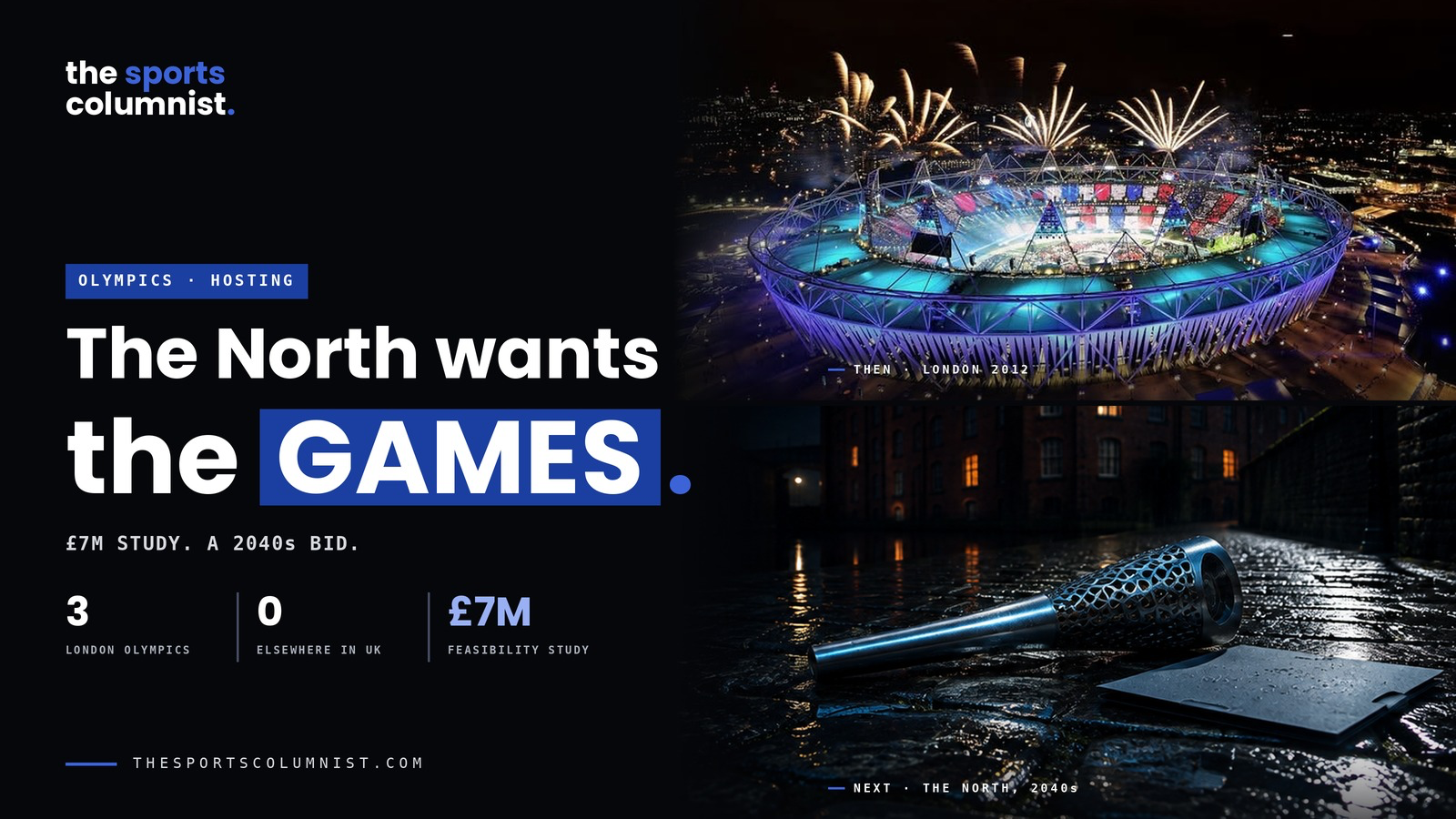
London has hosted the Olympics three times. Now the North of England wants its turn. A UK Olympic bid for the 2040s is moving from talk to paperwork. Chancellor John Healey will announce £7 million in funding for a full feasibility study for a “Northern Games”, and Prime Minister Andy Burnham has called an Olympic bid “something everyone can get behind”. In our view, the real story isn’t the money. It’s the model. Britain is testing whether a whole region, rather than one capital city, can win and afford the world’s most expensive sporting event.
What happened
The idea has moved quickly this year. In May, the government commissioned UK Sport to evaluate the feasibility, costs and potential benefits of a bid, using a multi-city hosting model including Manchester, Liverpool, Sheffield and Newcastle, as part of a wider economic and sporting regeneration project. UK Sport has since submitted its strategic assessment. sportsprosportspro
The £7 million is the next step. The full feasibility study will look in more detail at how the Games would work in practice, including the venues and transport links needed and the prospects of a winning bid. The government will work with UK Sport, northern mayors and the British Olympic and Paralympic Associations, which would ultimately be responsible for submitting a bid.
That last point matters. The government has said any future bid would be decided by the British Olympic Association, not by ministers. The state can fund the study and back the idea, but the sports bodies make the call. aol
Why the North, and why now?
There are two reasons: politics and the rulebook.
The politics is about fairness and regeneration. London has hosted the Games in 1908, 1948 and 2012, but nowhere else in the UK has. Under the banner of The Great North partnership, all 11 northern leaders wrote to the Culture Secretary arguing that a bid rooted in the North would be a fairer redistribution of major events across the country. The pitch is that the Games would be a catalyst for investment and jobs, not just a fortnight of sport.
The rulebook has changed too. The IOC no longer insists on a single host city. IOC changes now allow regions or countries to bid, rather than a single city, which makes a multi-city UK bid highly likely. Spreading events across Manchester, Liverpool, Sheffield, Newcastle and beyond suddenly becomes a strength, not a weakness. The North already has big stadiums, arenas and transport links, which keeps new building, and new cost, down.
The ambition is growing. One proposal from North Wales outlined a possible footprint stretching from Holyhead to Hull, with example venues for football, archery and sailing.
The business logic
An Olympic bid is an investment case, and three numbers frame it.
The bid itself costs real money. A London feasibility paper estimated the cost of a Summer Olympic bid at between £10 million and £20 million. The £7 million study is a down payment on finding out whether that spend is worth it.
Hosting costs are rising. UK Sport admits the rising cost of hosting major events has led it to take a more considered approach to which projects it backs. Any bid it supports must meet sporting, economic and societal criteria, and some events are deprioritised because their impact doesn’t justify the cost.
The pipeline is already full. The UK already has Euro 2028, the Tour de France and the 2031 Netball World Cup in Manchester coming up. That gives a bid momentum and a track record to point to.
In our view, the North’s strongest argument is the cost one. A Games built mostly on existing venues, spread across cities that already stage major sport, is exactly what the IOC now says it wants. That’s far easier to sell to the IOC and to taxpayers than a city building from scratch.
The challenges
London isn’t going away. The government faces questions over whether to pursue a regional bid or involve London. London Mayor Sadiq Khan backed a bid for the 2040 Games in 2025, arguing the capital could use its existing sporting infrastructure to host for a fourth time. Two rival British visions would weaken both.
The North has tried before. Manchester bid for the 1996 and 2000 Games and lost both times. A regional bid has to prove it can unite a dozen councils, mayors and transport bodies behind one plan.
The IOC has slowed everything down. IOC president Kirsty Coventry paused the host selection process last year, and the IOC has since added a “Strategic Dialogue” phase for greater transparency and cost control. Timelines for the 2040s are now less certain.
What it means for India
India is competing in the same new system. India submitted its letter of intent for the 2036 Games in 2024 and is in the Continuous Dialogue stage with the IOC, with Ahmedabad as the proposed host city. The 2036 host is now expected to be decided in mid-2029.
Britain’s approach offers India two lessons. First, the IOC’s shift to multi-city bids rewards existing venues and controlled costs over grand new builds. Second, a strong events pipeline builds credibility. Ahmedabad will host the 2030 Commonwealth Games and has bid for the 2038 Asian Games. Like the North of England, India is building its case event by event.
The question that matters
The North of England has the venues, the sporting culture and now the political backing. What it doesn’t yet have is a costed plan that proves an Olympics can regenerate a region rather than burden it. That’s what the £7 million is meant to find out.
So here is the question worth asking: can a multi-city Games deliver the regeneration that London 2012 promised, without the price tag that has scared other cities away?
At The Sports Columnist, we cover the deals, the money and the decisions behind sport. Every game has a second scoreboard, and for the North, the first score is a £7 million feasibility study.
Sources: UK government and HM Treasury announcements; UK Sport; Department for Culture, Media and Sport; Greater London Authority; International Olympic Committee; The Great North partnership. Correct as of 28 October 2026.
Read more from The Sports Columnist




comments.
0 commentsNo comments yet. Be the first to join the conversation.