The Sports Columnist
Investment

NBA Europe: which cities get a team, and why bidders are paying $1 billion

NBA Europe tips off in October 2027, but no team is confirmed yet. The 12 target cities, the $1bn bidders, and why the EuroLeague just said no.

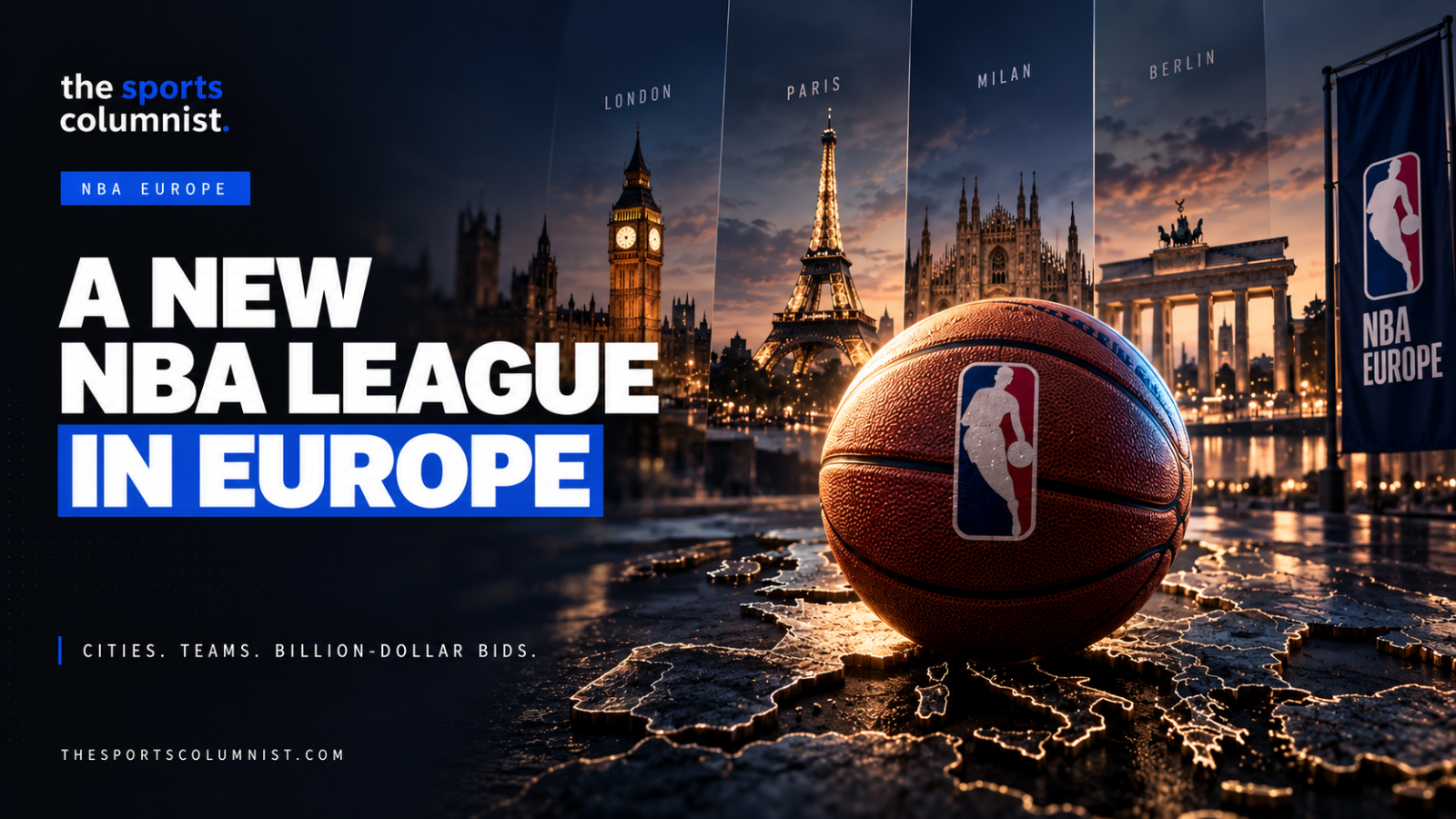
Cinematic banner: a basketball resting on the centre circle of a lit europe map

NBA Europe is a year from tip-off, and Europe still doesn’t know who’s playing. The NBA and FIBA have named 12 target cities and collected bids worth billions. They have just lost their best shot at a merger with the EuroLeague, and they are pressing ahead anyway. In our view, this is the biggest new-league bet in world sport right now. It’s also a useful test of whether American league economics can be exported to Europe.

What happened

The NBA’s European league is now in its decisive phase. The NBA and FIBA plan to launch it in October 2027 with 12 permanent franchises, plus four clubs that win rotating places through other FIBA competitions.

Bidding has been fierce. More than 20 groups submitted finalised bids, and bids came in at $500 million or higher in each of the 12 target cities, with several above $1 billion. In the latest round, multiple bids were more than double their first offers. 

Then, this month, came a setback. On 7 October, the EuroLeague’s member teams rejected an NBA proposal to operate together, and are expected to expand their own league instead, though talks continue. The NBA and FIBA responded with a joint statement confirming they will go ahead with NBA Europe whether or not they reach a deal with the EuroLeague. 

The latest word came on 20 October, the opening night of the NBA season. Deputy commissioner Mark Tatum said the NBA is close to finalising agreements with clubs for the league’s first phase and will announce those teams soon, while keeping the door open to a EuroLeague deal. 

So which cities get a team?

The short answer: none has been officially confirmed yet. The 12 cities in the running are Athens, Barcelona, Berlin, Istanbul, London, Lyon, Madrid, Manchester, Milan, Munich, Paris and Rome. That’s two each in England, France, Spain, Italy and Germany, plus Istanbul and Athens. But a bid in every city doesn’t guarantee a team in every city, and franchises are expected to be announced on a rolling basis. yardbarkertsn

Here is where the strongest reported interest sits:

  • London. It is the most sought-after destination, with multiple bids above $1 billion (£750 million). Sky News has reported bids or interest from Liberty Global, a consortium involving Daniel Levy and Jahm Najafi, and the Reuben family. 

  • Paris. Paris Saint-Germain, owned by Qatar Sports Investments, has submitted a bid. 

  • Rome. Lakers star Luka Dončić is part of a consortium that bought the Italian club Vanoli Cremona and intends to relocate it to Rome, having bid for a franchise. 

  • Milan. RedBird Capital, owner of AC Milan, has been in talks with the league about a franchise. 

  • Manchester. The owners of the city’s Super League Basketball team say they are in talks over a bid, and Manchester City’s and Manchester United’s owners have been linked with interest. 

  • Several cities at once. Buss Sports Capital, founded by members of the family that used to own the Lakers, has bid in several cities, including London, Manchester and Lyon. 

In our view, London is close to a certainty, and Paris, Rome and Milan look strong. The harder cities are the ones where the best existing clubs, such as Real Madrid, Barcelona, Fenerbahçe and Olympiacos, are still tied to the EuroLeague. Those clubs hold the key to Madrid, Barcelona, Istanbul and Athens.
The business model: why $1 billion?

Why would anyone pay $1 billion for a team that hasn’t played a game? Three reasons.

First, ownership of the league itself. Equity will be split evenly at the start, with NBA owners holding 50% and the 12 permanent team owners holding the other 50%. Buyers aren’t just buying a club. They’re buying a slice of a new league. 

Second, permanence. A permanent franchise can’t be relegated. That makes it a far safer asset than a European football club.

Third, the NBA’s financial model. Sources familiar with the business plan say initial franchises could break even by their third season, and the NBA’s forecasts anticipate more than $10 billion distributed across European basketball in the first decade. The NBA will also fund financial losses while the league establishes itself. 

The league is a hybrid. It will borrow American features such as a salary cap and local media rights, alongside ideas from European football, such as performance-based payouts and team-specific jersey deals. That second part matters for sponsors. Each team can sell its own shirt deal, and in Europe, that’s real money. 

The challenges

  • The EuroLeague isn’t going away. It currently has 13 permanent shareholder clubs but plans to approve up to eight long-term franchise licences as it expands to 24 clubs, with new franchises expected to be announced in mid-November. Europe could end up with two rival top-tier leagues competing for the same players, fans and broadcasters. 

  • Some teams start from nothing. Not every target city has a top-flight basketball club, so some franchises will have to be founded from scratch. Building a fanbase takes years, whatever the budget. 

  • The timing could slip. There has been speculation that the debut could be pushed to autumn 2028 while infrastructure is built out. The NBA insists October 2027 still stands. 

The question that matters

The NBA isn’t short of interest. France has 17 international players in the NBA this season, the most of any country, and the first time in 13 seasons that a country other than Canada has led. Talent and money clearly exist. The real test is whether European fans will choose a new league over the clubs and competitions they already love. 

So here is the question worth asking: can the NBA build a European league without Europe’s biggest clubs, or will it have to pay the EuroLeague’s price to get them?

At The Sports Columnist, we cover the deals, the money and the decisions behind sport. Every game has a second scoreboard, and in Europe, the bidding war has started before the first tip-off.

Sources: NBA and FIBA statements; remarks by NBA deputy commissioner Mark Tatum (20 October 2026);

Read more from The Sports Columnist

comments.

0 comments

No comments yet. Be the first to join the conversation.

read next.

All stories →

The business of sport, every Monday, in five minutes.

The Dugout is our free weekly newsletter: the deals, the money and the decisions, explained.

Join founders, marketers and students across India. No spam, ever.