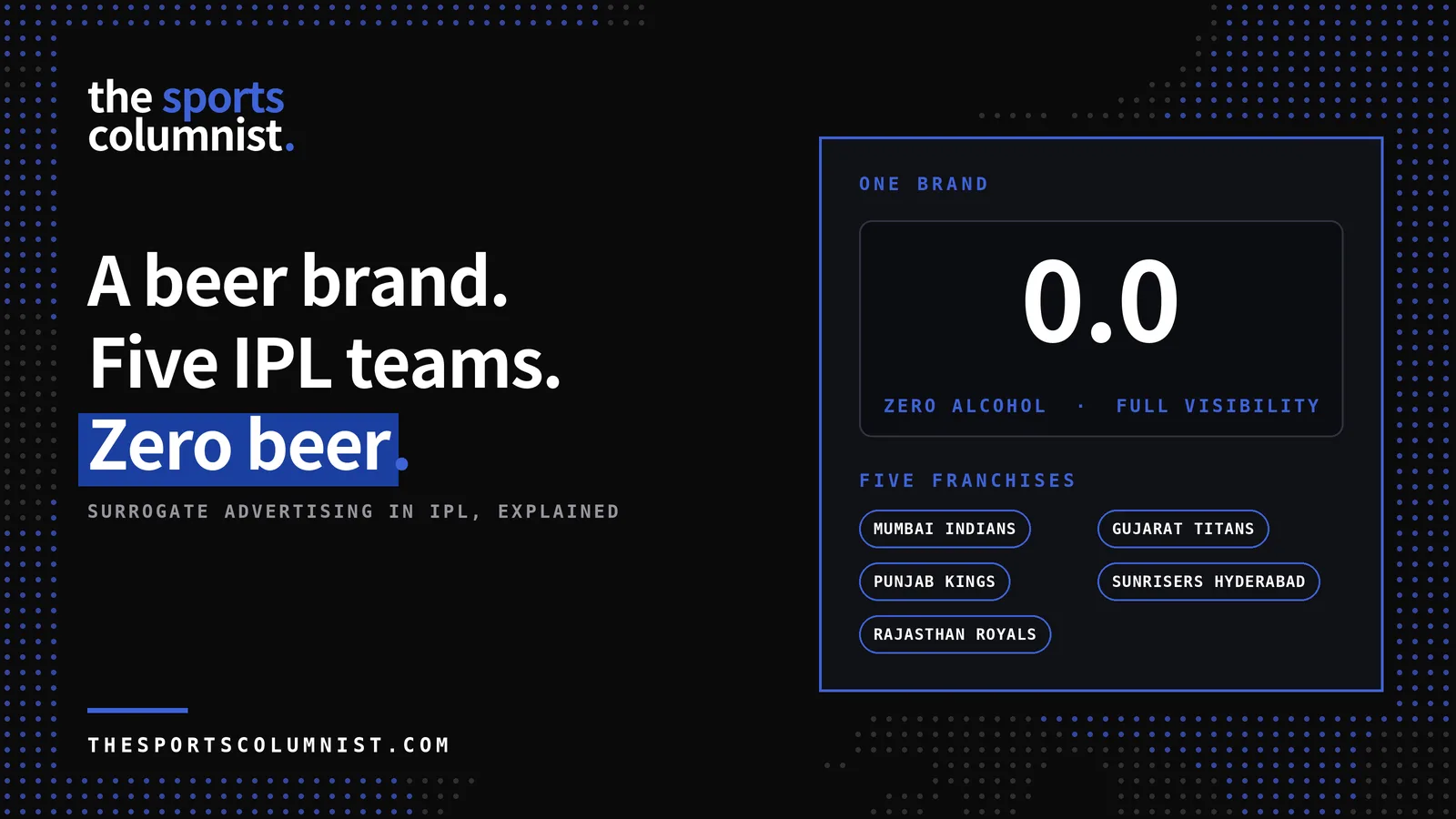
A beer brand signed up with five IPL teams this season. Except it isn't selling beer. Budweiser 0.0, AB InBev's non-alcoholic beer, walked into the 2026 IPL through a door that alcohol brands can't use, and its playbook is one of the clearest lessons yet on surrogate advertising in IPL.
To understand why, you need to know two things: what the law says a liquor brand can't do around cricket, and what it says the same brand name can still do.
The deal: one brand, five franchises
On 29 March 2026, Budweiser 0.0 announced partnerships with five IPL teams at once: Mumbai Indians, Gujarat Titans, Punjab Kings, Sunrisers Hyderabad and Rajasthan Royals (Storyboard18). It was the brand's IPL debut, coming soon after its first partnership with the ICC Men's T20 World Cup 2026.
The plan goes beyond a logo. Budweiser 0.0 said it would release limited-edition merchandise inspired by each team and take its "In the Hands of Fans" campaign from a national message down to city-level team loyalty. In the words of Vineet Sharma, Vice President of Marketing at AB InBev India: "Cricket is one of India's most powerful cultural connectors."
Why a beer brand can't just advertise beer
In India, liquor advertising is banned on television, both directly and through surrogates, under the advertising code that governs cable TV. In 2022, the Central Consumer Protection Authority's guidelines went further, saying no surrogate or indirect advertisement can be made for goods whose advertising is already prohibited.
Cricket is where this rule bites hardest. The IPL is one of the biggest audiences any brand in India can buy into, and alcohol companies want to be part of the match-watching experience as much as anyone. The government has noticed: ahead of IPL 2025, the Health Ministry wrote to IPL chairman Arun Singh Dhumal asking for a complete stop to surrogate tobacco and alcohol promotion during the tournament, in stadiums and on broadcasts.
Surrogate advertising, and where the line sits
Surrogate advertising is when a brand that can't advertise its main product promotes a different product under the same name. For years, cricket viewers have seen liquor brand names on soda, packaged water, music, glassware and playing cards. The product on screen is legal to advertise. The name it carries is the real message.
The law doesn't ban a shared brand name on its own. According to ASCI, a brand extension can be advertised if it meets two tests:
It must not hint at alcohol. The ad can't imply or allude to the liquor category.
It must be a real business. The extension has to show substantial sales, distribution or investment, not exist only as a vehicle for ads.
This is where Budweiser 0.0 is different from a soda with a whisky name. A non-alcoholic beer is a real product that people actually buy and drink. Critics will still say it keeps the Budweiser name in front of cricket fans. Supporters will say it is exactly what the rules allow: a genuine product, advertised on its own terms. Both are partly right, and that tension is the whole story.
Why five teams beat one
The smarter part of this deal is not the product. It's the structure.
Most brands pick one IPL team and live with its fortunes. Budweiser 0.0 spread itself across five franchises with fan bases in Mumbai, Gujarat, Punjab, Hyderabad and Rajasthan. That brings three advantages:
More cities, one campaign. Each team has its own loyal base. Five partnerships put the brand inside five regional fan cultures with a single national idea.
Less dependence on results. If one team has a poor season, four others are still playing meaningful matches. The brand's visibility doesn't rise and fall with one scoreline, which is why a dull result can still be good business.
More matches on screen. With five of the ten teams, the brand is linked to a large share of the league's fixtures, including games where its partners play each other.
Team-specific merchandise turns this into something fans can hold, which matters more for a brand that can't rely on traditional TV advertising alone.
The lesson for sports business
For anyone studying sports management, this deal is a case study in working inside the rules rather than around them. The restriction didn't keep AB InBev out of cricket. It shaped how the company came in: with a real product, a multi-team structure and a fan-first campaign.
It also shows where the debate is heading. Regulators want sport kept clear of alcohol and tobacco promotion. Brands want cricket's audience. Non-alcoholic products sit right on that line, and the IPL is where the line gets tested every season.
Sponsorship isn't always about the biggest cheque. Sometimes it's about the smartest structure.
Had you noticed how common surrogate advertising is in the IPL, or is this the first time you're seeing it? Tell us in the comments, and follow The Sports Columnist for the business side of the game.

comments.
0 commentsNo comments yet. Be the first to join the conversation.