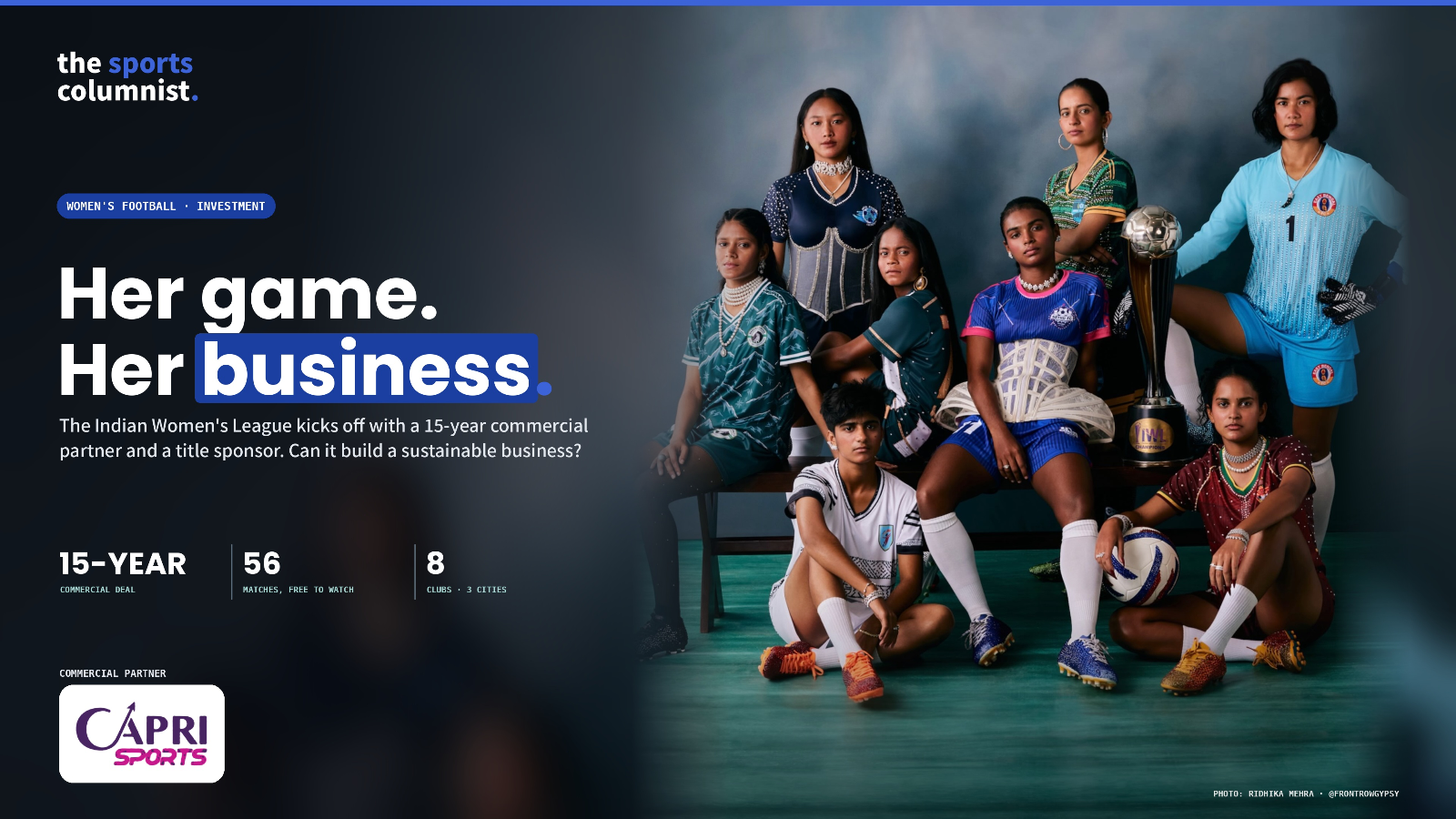
The Indian Women’s League kicks off on 13 November with something it has never had before: a long-term commercial partner and a title sponsor in place before a ball is kicked. Indian women’s football investment is entering a new phase. The question now is whether a commercial model can turn into what the league really needs: stronger clubs, better-paid players and a pipeline of talent.
What’s happening
The new season starts this week. It will start on November 13, 2026, with eight clubs competing across Kolkata, Jamshedpur and Bengaluru. It’s a big change in format: instead of concentrating matches in West Bengal, the AIFF has planned fixtures across three cities, and the season runs to the end of January, with the final fixtures scheduled for January 23, 2027.
The new commercial model
A 15-year commercial partner. In September, the All India Football Federation (AIFF) and Capri Sports entered into a 15-year partnership for the commercial development and marketing rights of the Indian Women’s League (IWL) and Indian Women’s League 2 (IWL 2). The AIFF’s stated aim is creating stronger and more sustainable platforms for clubs and players while increasing the reach and commercial value of women’s club football in India.
A title sponsor, quickly. A month later came the first big deal. The multi-year agreement marks the first major sponsorship milestone since Capri Sports secured a 15-year commercial development and marketing partnership with the All India Football Federation (AIFF). Lxme’s title partnership with the Indian Women’s League spans three years, beginning with the 2026–27 season, and the brand fit is clear: Lxme is a financial platform built exclusively for women.
Free to watch. Instead of selling broadcast rights, the league is chasing reach: all 56 matches of the 2026–27 IWL season are scheduled to be streamed free on the AIFF’s YouTube channel. The second division is also set to receive wider digital coverage through a partnership between Capri Sports and SportVot.
Room to grow. The AIFF has also set targets: it is targeting an expansion to 10 teams by the 2028-29 season and ultimately to 12 teams by 2032.
The Bengaluru connection
Bengaluru is part of the story this season. The city is home to Kickstart FC, one of the IWL’s eight clubs, which plays at the Bangalore Football Stadium. And the league’s final phase comes to the city in January, with fixtures such as Gokulam Kerala FC vs Kickstart FC listed for Bengaluru (TBC).
The city’s footprint goes deeper, too: Bengaluru clubs such as Kemp and Misaka United play in the second-tier IWL 2. In our view, that makes Bengaluru one of the most important cities for the women’s game, and a natural place to build crowds, sponsors and community around it, especially in a city already full of turfs and amateur players.
Who actually benefits?
The league and the AIFF: a long-term partner brings stability, marketing and someone whose job is to grow the league’s value, rather than running it season to season.
Capri Sports: a 15-year deal is a long bet. If women’s football in India grows, the value of those commercial rights grows with it.
Sponsors like Lxme: a chance to own a women’s sports property early, at a lower price than in men’s sport, and with a strong brand story.
Clubs and players: this is the big question. Visibility, free streaming and sponsors are a start, but the reports we reviewed don’t spell out how much money will reach the clubs, or how player salaries will change.
What would make it sustainable?
In our view, four things will decide whether this turns into a real business:
Money reaching the clubs, through a share of central sponsorship and commercial revenue, not just exposure.
Better player pay and contracts, so the best players can make football their job.
Crowds and local fans, especially in host cities like Bengaluru, to build matchday revenue and atmosphere.
A pathway from IWL 2 and state leagues to the top flight, so talent and clubs can rise.
There’s already proof that investment can work. As one analysis puts it, East Bengal’s domestic dominance and continental breakthrough have established a benchmark for other Indian clubs, while the Capri Sports partnership, LXME sponsorship and expanded broadcasting plans provide a stronger commercial foundation.
The risks
Reach before revenue. Free YouTube streaming builds an audience but brings in little direct money. The league has to turn viewers into sponsorship and commercial value.
One sponsor isn’t a business. A title sponsor is a strong start, but a sustainable league needs a broader set of partners.
A long road. Fifteen years is a long partnership. Results won’t come in one season, and patience will be tested if growth is slow.
The question that matters
Will this new money build stronger clubs and better-paid players, or just better branding? The Indian Women’s League now has a commercial partner, a title sponsor and a bigger stage than ever. Whether it becomes a sustainable business will depend on how much of that value reaches the people playing the game.
At The Sports Columnist, we cover the deals, the money and the decisions behind sport. Every game has a second scoreboard, and for Indian women’s football, a new one starts on 13 November.
Sources: AIFF; Business Standard, India Sports Hub, Khel Now and other reports, September–November 2026.
Read more from The Sports Columnist
→ Women’s sports valuations are soaring. Here’s why investors are betting on women’s leagues
→ Bengaluru’s turf culture: how five-a-side became the city’s social life
→ Get The Dugout, our free newsletter, every Monday

comments.
0 commentsNo comments yet. Be the first to join the conversation.