Bengaluru’s turf generation: how five-a-side became the city’s social life
Late-night games, WhatsApp groups, corporate leagues and box cricket: how Bengaluru’s turfs became more than pitches, and why the city’s turf culture is here to stay.
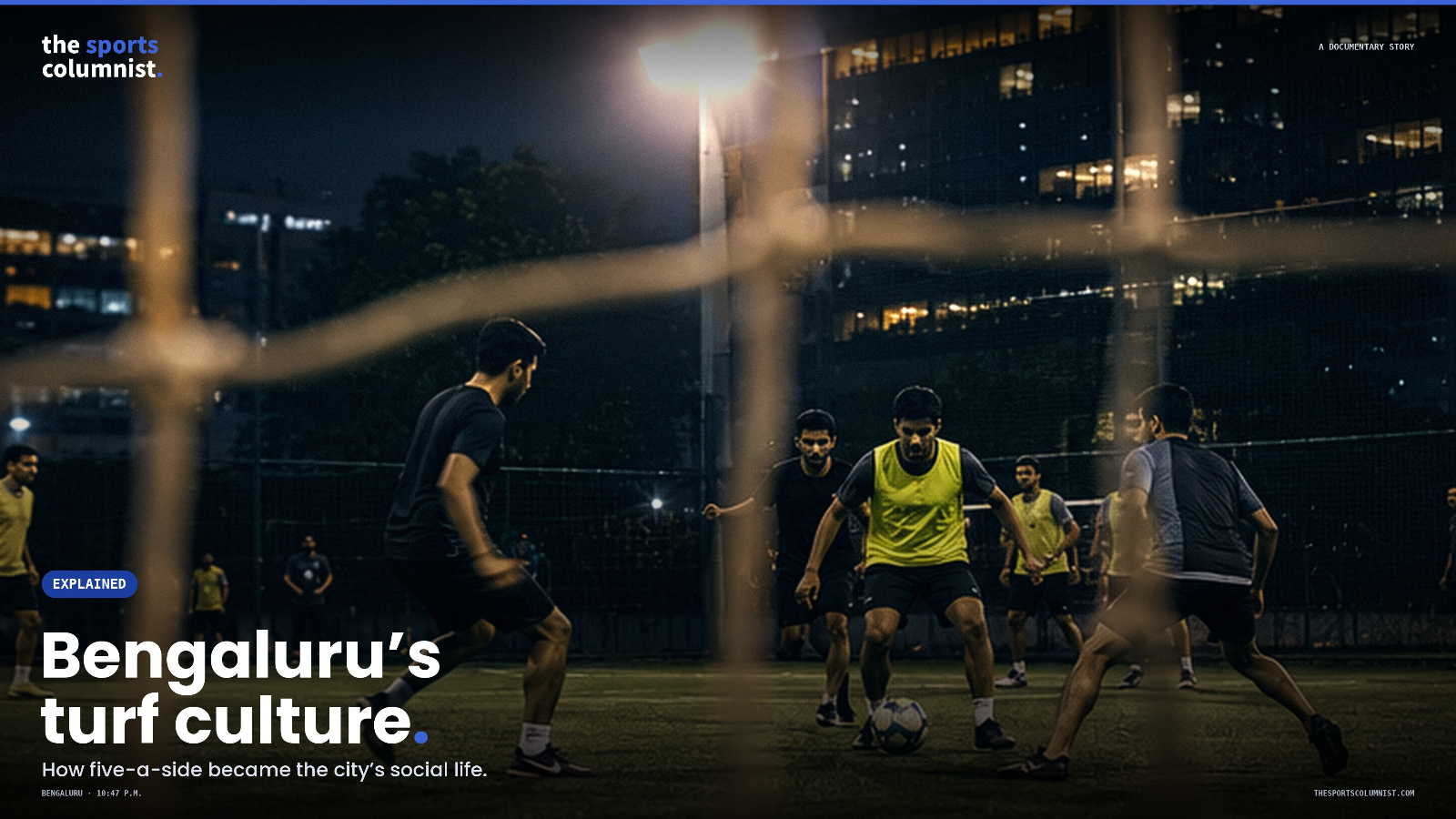
Ask a young professional in Bengaluru what they’re doing on a Tuesday night, and there’s a fair chance the answer is “turf”. In a city famous for its traffic, start-ups and late-night calls with colleagues in other time zones, small floodlit pitches have quietly become something bigger than a place to play. They’re where friendships start, office teams bond, strangers become regulars, and a cricket-mad city discovers football. This is the story of how Bengaluru turf culture was built, and what it says about the way the city lives now.
A city that ran out of grounds
Bengaluru grew faster than its playgrounds. As apartments and tech parks spread across the city, open grounds became harder to find, especially in the new neighbourhoods where young professionals live. The turf filled that gap: a small fenced pitch, artificial grass and floodlights, squeezed onto a rooftop, a vacant plot or the edge of a mall.
Industry guides describe the same pattern across Indian cities, pointing to absence of open playgrounds in cities and high hourly rental demand. In our view, Bengaluru felt it more sharply than most, because its population of young, fitness-minded workers grew faster than almost anywhere else in India.
Night became playtime
The most distinctive thing about Bengaluru’s turf culture is when it happens. Many of the city’s workers start late and finish late, working with teams in Europe and the US. So sport moved to the hours that were left: after 9 p.m., and often past midnight.
Turf owners noticed. Industry guides note that working professionals are attracted to night games, and that while weekend evenings sell out, daytime hours are hard to fill. In our view, that’s the clearest sign of a culture shaped by the city’s work patterns: the busiest time on a Bengaluru pitch is when most other cities are asleep.
From friends to strangers: the app effect
In the past, playing football meant having enough friends who were free at the same time. Apps changed that. Booking platforms let anyone find a pitch nearby, but some went further, turning booking into community. Playo, one of the best-known Bengaluru-born apps, describes itself as a way to meet sports enthusiasts and book sports venues near you, with features to find players and groups based on skills, interests, and timing preferences and to host matches.
Alongside the apps came the WhatsApp group: “Sunday 9 p.m. game, need two more”. As one Bengaluru football professional has put it, WhatsApp groups and community circles contribute to the strong community football culture in the city.
In our view, this is the real shift. For many newcomers to the city, a turf game is how they meet people. It’s a social life that doesn’t revolve around a bar or a restaurant.
The office goes to the turf
Companies saw the value quickly. Corporate leagues and team games became part of office culture, as a way to build teams across departments, welcome new hires and keep people healthy. Guides to the city note that weekend amateur leagues for cricket and football are common among corporate employees. Industry suppliers describe sponsored corporate tournaments on weekends as a core part of the turf business.
For turfs, corporate bookings are valuable because they’re regular and predictable. For employees, they blur the line between work and play, and for many, they’re as important as any office party.
A cricket city learns football
India is a cricket country, but Bengaluru has a strong case as its football capital. The city has a top-flight club in Bengaluru FC, which drew praise for bringing a new sense of professionalism to Indian football. Below the professional level, turfs gave thousands of people a place to play the game regularly.
Some in the local game make bigger claims. One Bengaluru football professional argues the city boasts the highest number of 5-a-side and 7-a-side turfs, creating a vibrant football culture, and that it leads in female football participation. These are claims, not official statistics, but they reflect a widely shared sense that football has found a home in Bengaluru’s turf culture.
Gully cricket moves indoors
Cricket didn’t disappear. It changed shape. Box cricket, a short, fast, enclosed version of the game, became the turf’s other big format. Industry writers describe its rise in simple terms: box cricket has been on a rampage because it’s fast-paced, easy to organize and suits players of different ages.
In our view, box cricket is gully cricket rebuilt for the city: the same informal energy, with nets instead of walls, floodlights instead of streetlights, and a booking app instead of a knock on the neighbour’s door.
A whole economy around the game
Once people play regularly, they spend. Around Bengaluru’s turfs, a wider economy has grown: football boots and kits, coaching academies for children in the quiet morning hours, weekend tournaments with entry fees, and leagues with their own sponsors. For young players, the turf is often their first taste of organised sport. As one industry writer puts it, to most students playing on turf is the first experience of organized sports.
What the turf says about Bengaluru
Sociologists talk about the “third place”: somewhere that isn’t home or work, where people meet and belong. For a generation of Bengaluru’s young professionals, often far from their home towns, the turf has become that place. It offers fitness, friendship, competition and a break from screens, all for the price of a coffee each.
In our view, that’s why turf culture has lasted beyond a trend. It answers a real need in a fast, crowded, work-heavy city: a reason to switch off the laptop, show up at 10 p.m., and play.
The question that matters
Can Bengaluru’s turf culture grow into something bigger, with stronger community leagues, more women playing, and a pathway for talented players, or will it stay a late-night hobby for office workers? The pitches are full. What the city builds on top of them will decide whether the turf generation becomes a sporting generation.
At The Sports Columnist, we cover the deals, the money and the people behind sport. Every game has a second scoreboard, and in Bengaluru, it’s kept under floodlights.
Sources: Playo app listing; industry guides on the turf business, 2026; public commentary by Bengaluru football professionals. Some claims are attributed opinions rather than official statistics.





comments.
0 commentsNo comments yet. Be the first to join the conversation.