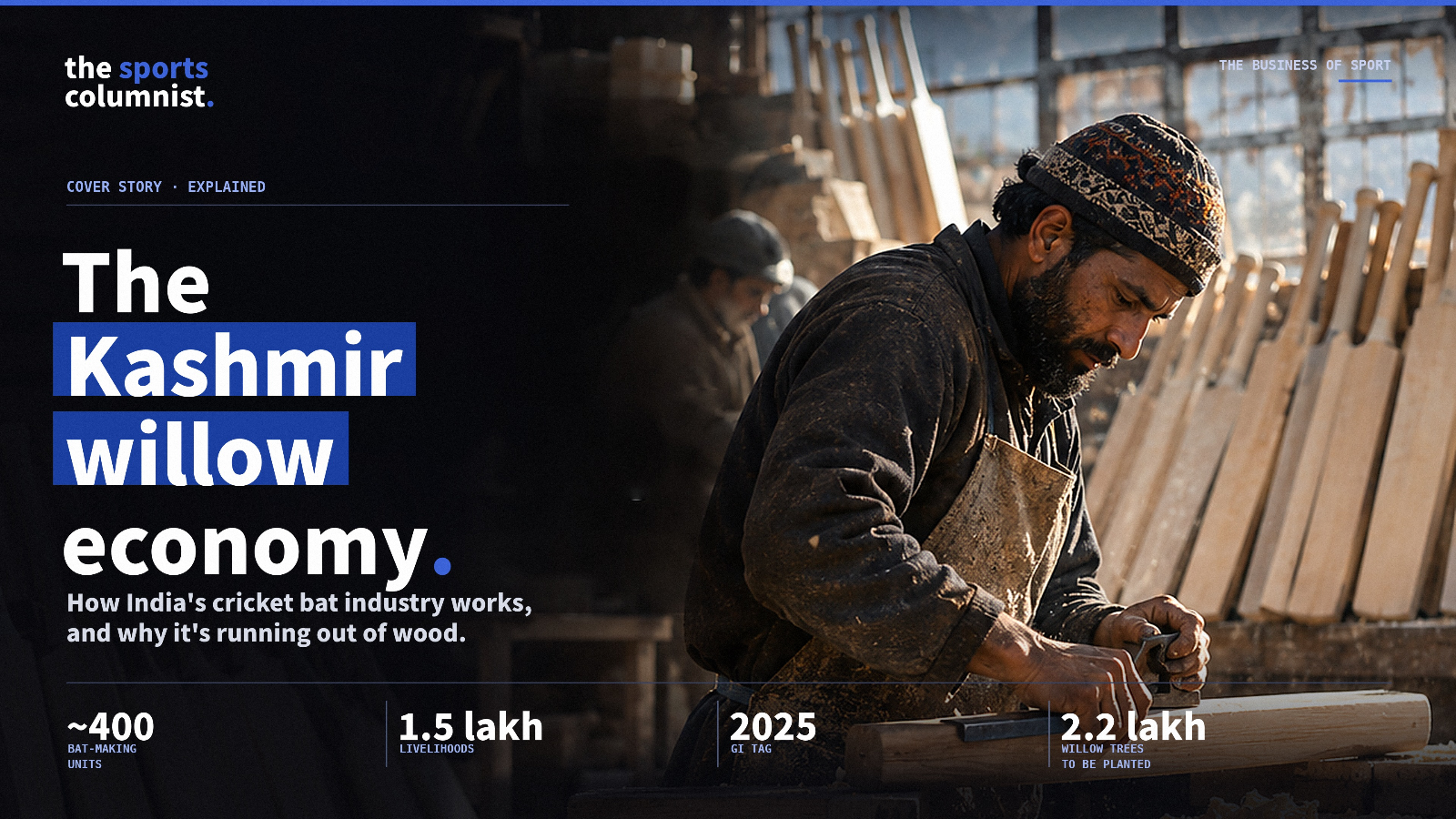
Every cricket bat starts as a tree. For India’s favourite sport, many of those trees grow in one valley. In south Kashmir, hundreds of workshops turn willow into bats used everywhere from local maidans to World Cups. The Kashmir willow bat industry has never been in more demand, and it has never been closer to running out of the one thing it can’t make: wood.
Where the bats come from
Drive along the highway through Sangam in south Kashmir, and you’ll see lines of shops display neat stacks of willow wood along a nondescript motorway. Behind them are small manufacturing units, where that willow is handmade into cricket bats that find their way to the rest of India and other cricket-playing nations around the world.
The cluster is large. Kashmir today has close to 400 cricket-bat manufacturing units, concentrated mainly in the Sangam-Awantipora belt. One recent count puts the formal side at 195 registered bat manufacturing units, primarily situated in south Kashmir, alongside approximately 150 cleft dealers. And it matters to the region: the industry supports approximately 1.5 lakh Kashmiris directly or indirectly.
How the industry works
The raw material. There are only two types of willow suitable for cricket bats: English willow and Kashmir willow. English willow is used for the most expensive professional bats, while Kashmir willow has traditionally been the affordable alternative.
From tree to bat. Willow trees are felled and cut into clefts (the rough blocks a bat is shaped from), dried, then pressed, shaped and finished by hand. It’s skilled work: as one local editorial put it, it needs a unique skill to chisel a bat from a raw willow.
The money. The sector is often described as a ₹700 crore industry, and bat manufacturers state that the supply crunch is impeding their ability to fulfill rising domestic and international orders as the industry strives toward a ₹700-crore valuation.
Kashmir willow’s global moment
For decades, Kashmir willow lived in English willow’s shadow. That’s changing. Afghanistan’s national team used Kashmir willow at the 2023 ODI World Cup. Exports took off in the two years after 2020, rising from virtually zero in 2020 to over 185,000 bats in two years. Players from Sri Lanka, West Indies, Oman, Bangladesh, UAE, and Afghanistan have chosen Kashmir willow.
The name itself is now protected: the industry received a boost with the Geographical Indication (GI) tag in 2025, enhancing its market value and reach.
Price helps too. English willow has become far more expensive: per foot, it has gone up from ₹300 in 2021 to ₹1,250. In our view, that makes a high-quality Kashmir willow bat one of Indian sport’s best value-for-money exports, if the wood holds out.
Why it’s under pressure
1. Not enough trees. The industry needs about 70,000 mature willow trees annually to meet current demand. But one estimate puts harvesting at around 1.2 lakh mature trees annually, far faster than trees are being replaced.
2. Trees take decades to grow. It takes about 20 years for a willow tree to mature, which means the next generation will face a severe shortage if we don’t take action now.
3. Farmers are switching crops. Many cultivators replaced willow with Russian poplar or converted their land to apple orchards, both of which offered quicker or more sustained financial returns. A willow supplier summed up the problem a few years ago: “A willow tree matures in 30 years and poplar in half the time, and it fetches the same price.”
4. Wood leaves the valley. Clefts are being sent to other bat-making centres: “Kashmir willow timber is being smuggled to places such as Jalandhar and Meerut, which have their own bat-making units and flourishing export industries.” That’s despite a long-standing rule: the government banned cleft exports to the rest of India or overseas 25 years ago.
5. Small makers are hit hardest. When quality willow becomes scarce or expensive, smaller units are the first to suffer, since they lack the reserves to stockpile timber or absorb rising costs.
What’s being done
Work has started. In April 2026, a large-scale willow plantation drive was launched at Momen Danji, Arwani in Anantnag, and SIDBI is currently supporting a year-long project intervention for promotion and development of Cricket Bat industry in Kashmir.
In July, the Chief Minister Omar Abdullah’s interaction with manufacturers at Sangam, his assurance of a steady supply of quality willow, was widely welcomed. The Forest Department has announced plans to plant 2.2 lakh willow trees across 200 hectares, aiming to expand production capacity to 50 lakh bats annually.
But trees planted today won’t be ready for a generation. The industry also needs measures that work sooner: stronger enforcement against smuggling, incentives for farmers to grow willow again, and support for small units.
The business lesson
The Kashmir willow story is a classic supply-chain problem. Demand is growing, international players are paying attention, and with a GI tag, the Kashmir willow brand has never been stronger. But the industry spent decades harvesting a resource without replacing it. In our view, the fix is as much about economics as forestry: willow has to pay farmers as well as apples and poplar do, or the trees won’t come back.
The question that matters
Can India turn Kashmir willow into a global premium brand before the trees run out? The bats are winning fans around the world. The next 20 years of planting will decide whether there’s still wood to make them.
At The Sports Columnist, we cover the deals, the money and the decisions behind sport. Every game has a second scoreboard, and for India’s bat makers, it starts with a tree.
Sources: Government of Jammu and Kashmir and Forest Department announcements, 2026; industry association statements; reporting from Kashmir, 2022–2026.
Read more from The Sports Columnist
→ Nike made a running shoe just for India. Here’s why the ₹3,795 price tag matters
→ Boldfit raised ₹400 crore. Can a homegrown brand win India’s fitness market?
→ India’s sports economy is worth ₹1.99 lakh crore. Here’s what that number tells us
→ Get The Dugout, our free newsletter, every Monday




comments.
0 commentsNo comments yet. Be the first to join the conversation.