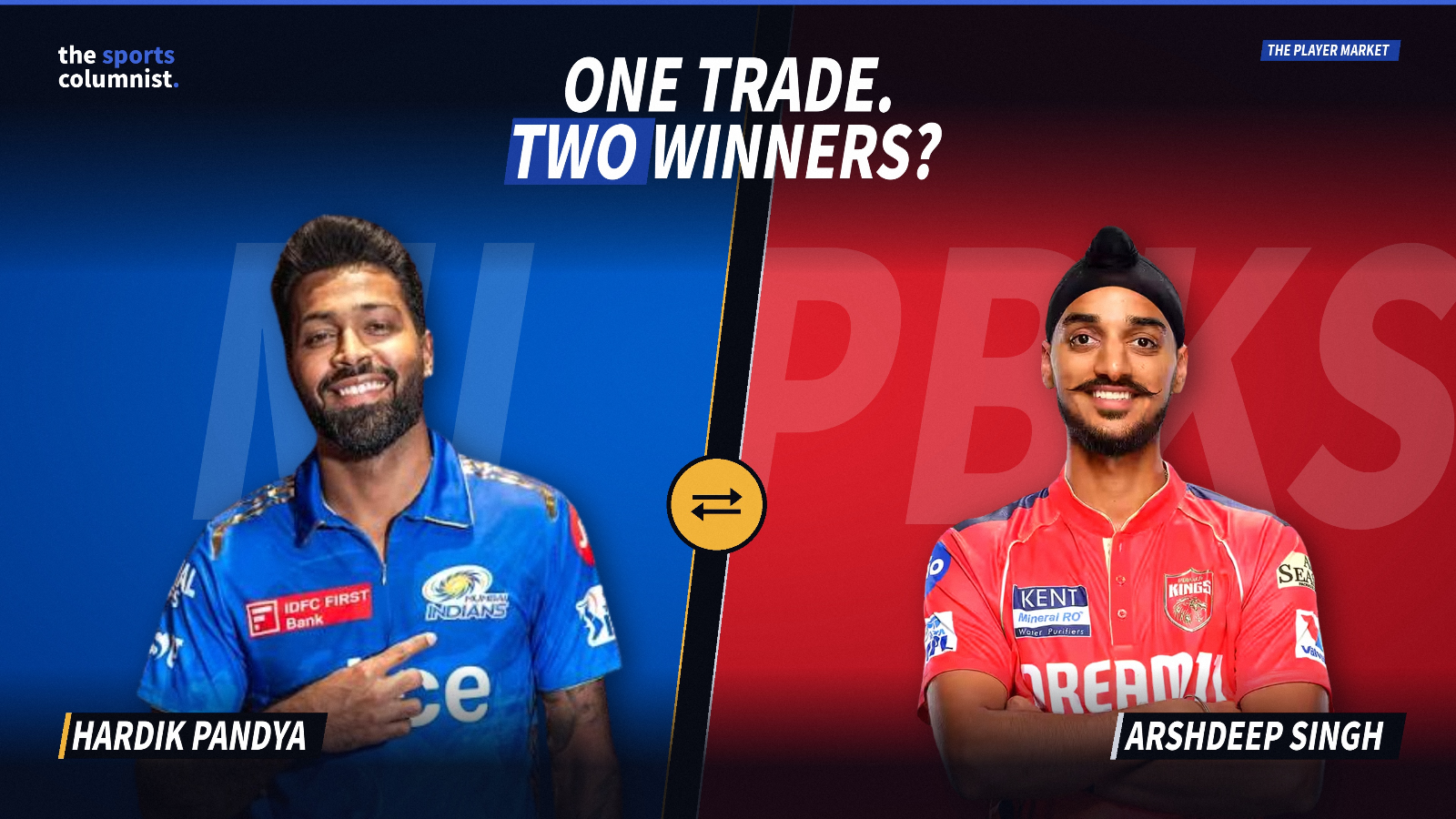
The IPL trade window has produced its biggest move yet. Mumbai Indians are set to send their captain, Hardik Pandya, to Punjab Kings, with left-arm pacer Arshdeep Singh going the other way. One-for-one swaps between two current India players almost never happen in the IPL. The Hardik Pandya Arshdeep Singh trade shows how franchises are starting to use trades as a serious strategic tool, not just a way to tidy up their squads.
What’s happening
According to reports, star all-rounder Hardik Pandya has been traded to Punjab Kings in exchange for pacer Arshdeep Singh, with Mumbai Indians and Punjab Kings agreeing to the swap ahead of the IPL auction later this year. A source quoted in the reports said: “The trade has been completed. Hardik is going to Punjab Kings and Arshdeep is moving to Mumbai Indians. Hardik is happy to play under Shreyas Iyer.”
It isn’t official yet. No third player will be part of the swap, but both cricketers must still sign off on the fine print. After that, the papers will require approval from the IPL authorities.
Why Mumbai made the move
For Mumbai, it’s part of a wider reset. The trade comes as a coaching overhaul continues in Mumbai Indians as Malinga, Mhambrey and Hopkinson exit. It also means Mumbai Indians (MI) will have a new captain for IPL 2027.
In return, Mumbai get one of India’s best death bowlers. Arshdeep is the highest wicket taker in Punjab Kings’ IPL history, and he joins an already impressive bowling side.
There’s also a fitness question behind the decision. Concerns remain over his fitness, as multiple injury setbacks have kept him away from competitive cricket since the previous IPL season. In our view, swapping an injury-affected all-rounder for a proven, in-form specialist is a classic risk-management call.
Why Punjab said yes
For Punjab, letting Arshdeep go wasn’t easy. One source said: “It was the decision of the captain and the coach to trade Hardik for Arshdeep, who has been with Punjab Kings for a very long time and has become the player he is today following his success with the franchise. For the owners, it was not an easy decision considering how Arshdeep has risen and performed so well for the franchise.”
What they gain is an all-rounder who has won the IPL as a captain, and one of the biggest names in Indian cricket. That matters commercially as well as on the field: star players bring fans, sponsors and media attention, especially for a franchise still chasing its first title.
The business of IPL trades
Trades used to be rare footnotes in the IPL. Now they’re becoming a market of their own.
Hardik has done this before. His move back to Mumbai in 2023 was the biggest trade of its time. It was an all-cash deal comprising Mumbai paying INR 15 crore ($1.8 million approx.) as Hardik’s salary and an undisclosed transfer fee to Titans. Hardik stands to earn upto 50% of the transfer fee.
Cash deals versus swaps. Most big IPL trades are cash deals, because teams need room in their auction purse. A one-for-one swap of two stars avoids that problem: each team replaces a big salary with another, without needing to free up money.
Teams are using the window aggressively. As one report noted, teams have made the most of the trade window ahead of the deadline, making several changes to strengthen their squad. Hardik himself appeared on several teams’ wishlists during the trade window.
In our view, this is the IPL maturing. Like the NBA or the NFL, franchises are learning that trades can fix a squad faster and more cheaply than an auction, and that a well-timed trade can be as valuable as a big auction buy.
A career that tells the IPL’s story
Hardik’s journey mirrors the league’s own growth. Pandya first joined Mumbai, which is owned by Nita Ambani — wife of India’s richest man, the Reliance Industries billionaire Mukesh Ambani — as an uncapped player in 2015 for $11,000. He went on to win titles with Mumbai, led Gujarat Titans to the title in their first season, returned to Mumbai in a record trade, and is now set to start a new chapter in Punjab.
The question that matters
Who wins this trade? Mumbai get a proven, fit match-winner with the ball. Punjab get a superstar all-rounder with captaincy experience, and the brand power that comes with him, but also the fitness risk. The answer will play out on the field in 2027. Off the field, one thing is already clear: in the IPL, the trade window is now a market that matters.
At The Sports Columnist, we cover the deals, the money and the decisions behind sport. Every game has a second scoreboard, and in the IPL, trades are now part of the score.
Sources: reporting by ESPNcricinfo, Business Today, Deccan Herald and others, November 2026; ESPNcricinfo reporting on the 2023 trade.
Read more from The Sports Columnist
→ The IPL’s most valuable teams
→ Is the IPL’s money machine slowing down?
→ Cricket Australia is selling the Melbourne Renegades. Is the Big Bash the next IPL-style investment?
→ Get The Dugout, our free newsletter, every Monday

comments.
0 commentsNo comments yet. Be the first to join the conversation.