The company behind every live odd. Photo: The Sports Columnist
The company behind the odds
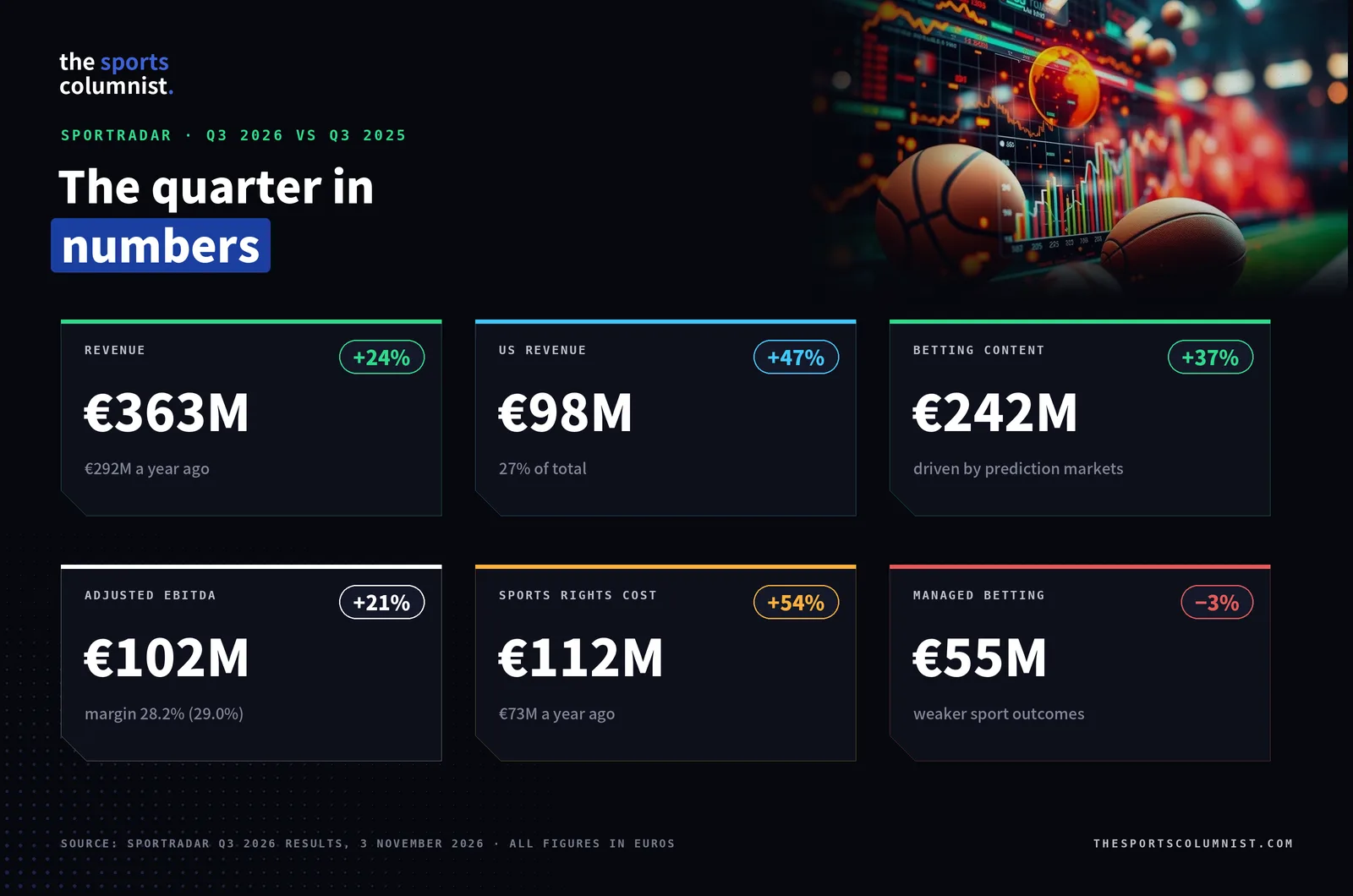
Every time a betting app updates the odds mid-match, the data almost certainly came from a company most fans have never heard of. Sportradar revenue hit €363 million in the third quarter of 2026, up 24% on a year earlier, the Swiss data firm reported on 3 November (Sportradar).
Its US business grew even faster, up 47%. And it now supplies prediction market Polymarket with data for more than 20 leagues and competitions.
The headline numbers tell a simple story: as more people bet and trade on live sport, the company selling the live data gets paid on every match.
The quarter in numbers
Sportradar grew revenue, profit and cash all at once in the July–September quarter.
It also reiterated its full-year guidance: revenue of €1.52 billion to €1.53 billion, growth of 19% to 21% at constant currency. Over nine months, revenue is already €1.09 billion. The company has no debt and has bought back US$408 million of its own shares so far in 2026.
How Sportradar makes money
The model has three steps.
Buy the rights. Sportradar pays leagues for official data and betting video rights. Its partners include the NBA and WNBA, NHL, MLB, ATP, UEFA, FIFA and the Bundesliga. In Q3 alone, sports rights cost it €112 million, up from €73 million a year earlier.
Package it. It turns more than a million events a year into live scores, odds feeds, streams and integrity monitoring.
Sell it on. Sportsbooks such as Flutter and DraftKings, tech giants such as Google and Microsoft, and prediction markets such as Kalshi and Polymarket all buy the feeds.
The biggest division, betting technology and solutions, made €297 million in Q3, up 27%. Within it, betting and gaming content grew 37% to €242 million.
Leagues are not just suppliers. When the NBA renewed its deal in 2021, it took a roughly 3% stake in Sportradar as part of an eight-year agreement (Sportico). The league earns from the data, and from the company selling it.
America and prediction markets
Two things are driving the growth.
The US. Revenue from the United States rose 47% to €98 million, now 27% of the total, up from 23% a year earlier. Legal betting keeps spreading state by state, and every new sportsbook needs a data feed.
Prediction markets. Sportradar first supplied Polymarket with data for the ATP Tour, MLB, NHL, MLS and UFC. It has now expanded that deal to more than 20 leagues and competitions, adding the Bundesliga, European basketball and the tennis Grand Slams (SBC News). It also works with Polymarket's biggest rival, Kalshi.
That matters because prediction markets are now signing the biggest leagues directly. As we wrote when the NBA signed Kalshi and Polymarket, monthly trading on the two apps went from under $5 billion to about $24 billion in seven months. Sportradar does not need to pick a winner. It sells data to both.
The risks
The growth is real, but so are the weak spots.
Rights are getting expensive. Sports rights costs rose about 54% in Q3, faster than revenue. Leagues know their data is valuable and charge accordingly.
Margins slipped slightly. Adjusted EBITDA rose 21% to €102 million, but the margin fell from 29.0% to 28.2%.
Sport is unpredictable. Its managed betting services fell 3% to €55 million because results went the bookmakers' way less often. When Sportradar runs trading for clients, it shares the risk.
Regulation. Prediction markets face dozens of lawsuits from US states. If courts rule against them, one of Sportradar's fastest-growing customer groups could shrink.
The second scoreboard: data is the new broadcast right
For decades, leagues made their money from TV rights, tickets and sponsors. Sportradar's numbers show a fourth stream that is growing fast: the rights to every point, pass and ball, sold to the people who bet and trade on it.
For leagues, official data is now a product in its own right. Some, like the NBA, have taken equity in the companies that sell it.
For fans, the same data powers live stats, apps and second-screen experiences, not just betting.
For India, the picture is different. The 2025 online gaming law banned real-money gaming, so the betting side of this market is closed at home. But Indian sport is still followed by hundreds of millions, and the data from it is valuable to broadcasters, stats apps and global platforms.
The lesson is simple: every match now produces two products, the game and the data. The leagues that understand the second one will earn from both.
The takeaway
Sportradar is on track for more than €1.5 billion in revenue this year, built on something fans rarely think about: the data behind the game. As betting spreads in the US and prediction markets sign the world's biggest leagues, that data is becoming one of sport's most valuable assets.
At The Sports Columnist, we cover the money, deals and decisions behind sport. Every game has a second scoreboard, and Sportradar is the company that keeps it.
All financial figures are from Sportradar's Q3 2026 results, published 3 November 2026. Partnership details are from Sportradar and SBC News.
Should leagues sell their data to betting and prediction markets, or keep it closer to home?





comments.
0 commentsNo comments yet. Be the first to join the conversation.