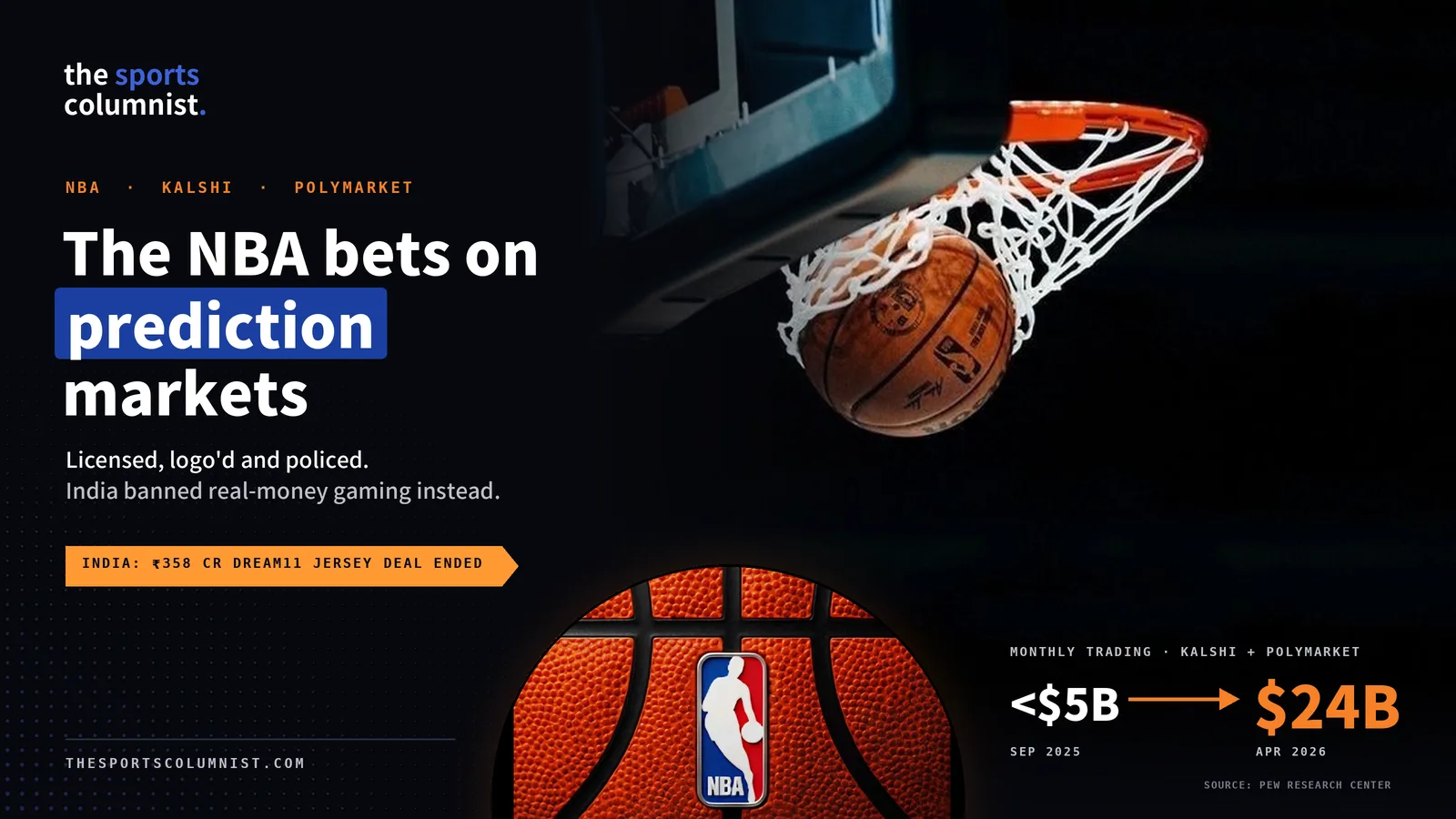
Licensed, logo'd and policed. India banned real-money gaming instead. Photo: The Sports Columnist
The NBA picks a side
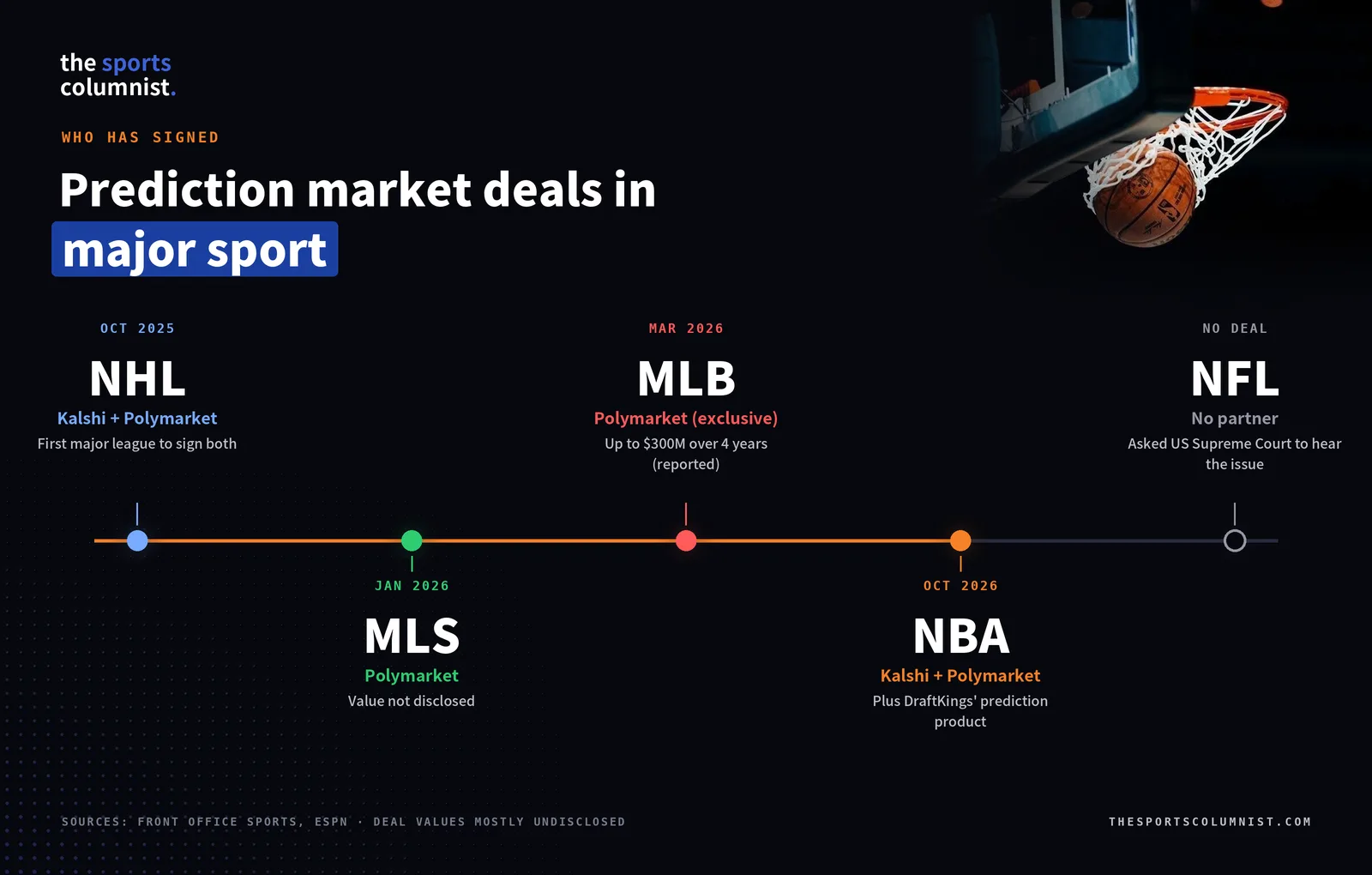
On 26 October, the league chose its partners for NBA prediction markets: Kalshi and Polymarket. Both are now the NBA's "preferred prediction market" platforms, with official league data and the right to use NBA and team logos in their apps and marketing (ESPN).
The league also widened its existing deal with DraftKings to cover DraftKings' own prediction product. Financial terms were not disclosed, and more partners are expected "in the coming weeks" (Front Office Sports).
A prediction market lets users buy "yes" or "no" contracts on an outcome, such as who wins tonight's game. Kalshi and Polymarket say they are regulated by the federal Commodity Futures Trading Commission (CFTC), not by state gambling regulators. That lets them reach states where sportsbooks cannot, a claim many states are fighting in court.
Why the NBA said yes
Kalshi and Polymarket were already listing NBA games before any deal was signed (Yahoo Sports). The partnership turns that into a licensed sponsor category that the league controls.
Control is the headline. Under the deals:
Players, and league and team employees, cannot trade on NBA event contracts.
The NBA is signing a memorandum of understanding with the CFTC to share information on suspicious trading.
Partners must follow the betting limits the NBA gave sportsbooks less than two weeks earlier. These ban player props such as first-basket scorer, and parlays built on unders for players expected to play limited minutes (Front Office Sports).
"Protecting the integrity of the game is our top priority," said Scott Kaufman-Ross, the NBA's head of media distribution and partnerships. He told ESPN the league had been "waiting for that moment" when the rules were clear enough to sign.
The NBA has also hedged. Its contracts cover a scenario in which prediction markets are no longer allowed to offer sports markets at all (ESPN).
Every league is picking a side
The NBA is not first. The NHL signed Kalshi and Polymarket as official partners in October 2025. Major League Baseball made Polymarket its exclusive prediction market partner in March 2026, in a deal sources put at up to $300 million over four years (Front Office Sports).
The NFL is the big holdout. It has no prediction market partner, and in October it asked the US Supreme Court to hear the issue, arguing that states should regulate these markets (ESPN).
The money behind prediction markets
The leagues are following the volume. Monthly trading on Kalshi and Polymarket combined rose from under $5 billion in September 2025 to about $24 billion in April 2026. For comparison, legal US sportsbooks took about $14 billion a month on average in 2025 (Pew Research Center).
Sport is the engine. Since July 2024, sports contracts have made up 80% of Kalshi's volume and 39% of Polymarket's, according to Pew's analysis of trading data from The Block.
For a league, that is a new sponsor category arriving while the money is still growing fast. It also brings a new integrity risk, which is why the NBA wrote the trading limits into the deal.
The fight is not over
The legal question is still open: are sports contracts financial products for the federal CFTC, or sports bets for state regulators?
New York, where the NBA is headquartered, is suing prediction markets, alleging they offer illegal sports betting.
New Jersey has asked the US Supreme Court to take the issue, and the NFL has backed that request (ESPN).
Kalshi and Polymarket face dozens of lawsuits from state gambling commissions and officials (Front Office Sports).
The NBA says it will stay out of it. "We'll let the courts decide," Kaufman-Ross told ESPN.
Fans are less relaxed. A Reddit thread on the deal drew hundreds of comments, with one fan calling it an "obvious bad idea" (Yahoo Sports). The WNBA was left out: platforms must sign separate deals for its rights.
The second scoreboard: India went the other way
America's leagues have decided to license and police real-money markets on their games. India shut real-money gaming out altogether.
In August 2025, Parliament passed the Promotion and Regulation of Online Gaming Act. It bans real-money games and any advertising for them, while allowing social and subscription games (ESPNcricinfo).
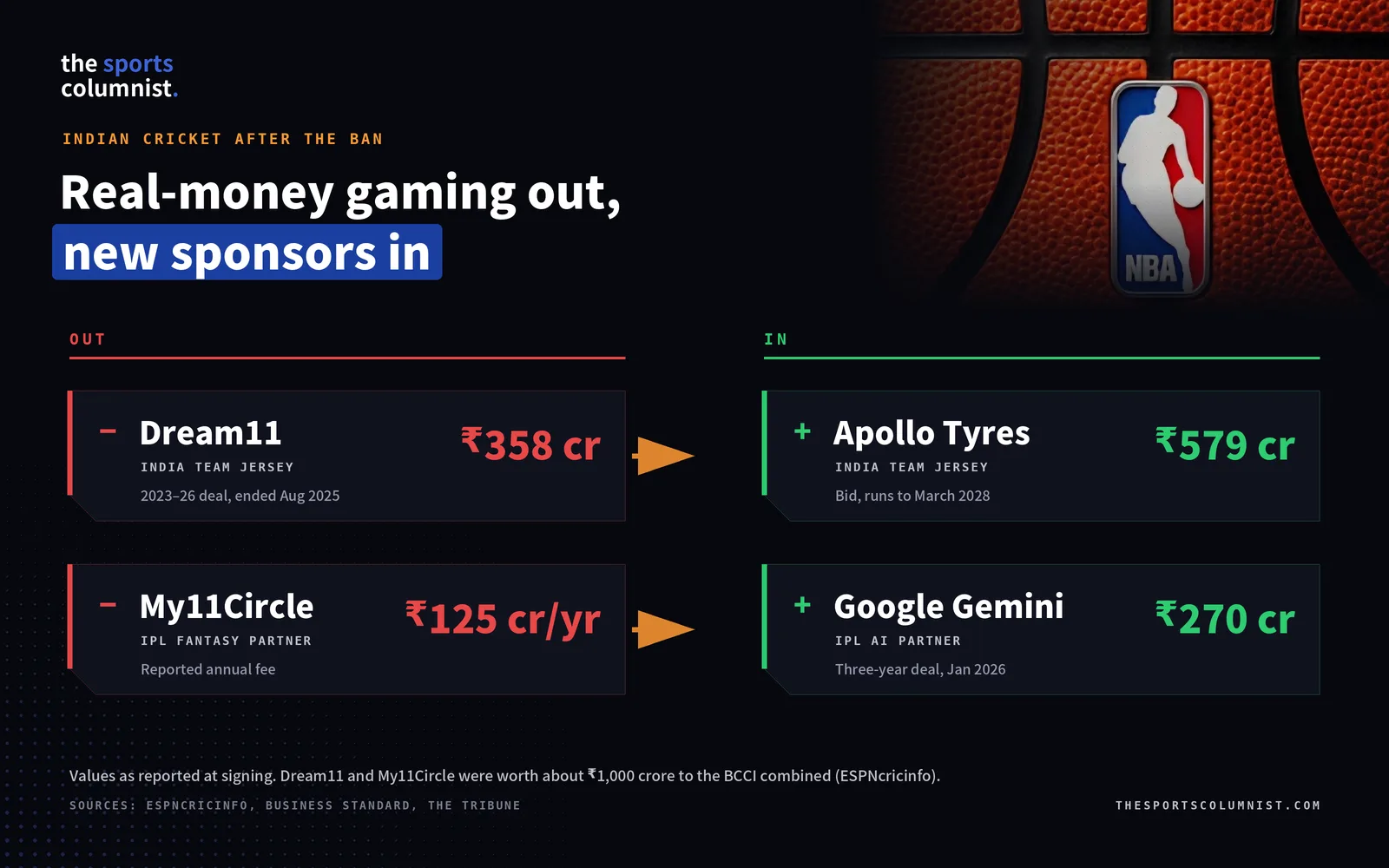
Cricket felt it at once. Dream11 ended its ₹358 crore ($44 million) deal as India's jersey sponsor. Dream11 and My11Circle together had been worth about ₹1,000 crore to the BCCI through India and IPL sponsorships, according to ESPNcricinfo.
The BCCI found new money quickly. Apollo Tyres took the India jersey in September 2025 with a ₹579 crore bid, running to March 2028 (Business Standard). Google's Gemini signed a three-year, ₹270 crore IPL deal in January 2026 (The Tribune).
The lesson cuts both ways. India gave up a big sponsor category to protect users. The NBA kept its category and wrote integrity rules into the contract instead. Both are bets on the same fan behaviour.
The takeaway
The NBA did not create prediction markets. They were already trading its games. What the league bought is control: over the data, the logos, the markets on offer and who is allowed to trade.
At The Sports Columnist, we cover the money, deals and decisions behind sport. Every game has a second scoreboard, and in the NBA, fans can now trade on it.
Deal terms for Kalshi and Polymarket were not disclosed. The MLB figure is from sources cited by Front Office Sports, and trading volumes are from Pew Research Center. Indian sponsorship values are as reported at signing.
Should Indian sport stay out of prediction markets, or learn from the NBA and regulate them?

comments.
0 commentsNo comments yet. Be the first to join the conversation.