The Sports Columnist
Sponsorship

Allianz Secures LA28 Beach Arena Naming Rights. Why Olympic Sponsorship Is Changing

Allianz will become the first brand to have its name on an Olympic competition venue. The LA28 deal reveals how the Games are expanding their commercial sponsorship model.

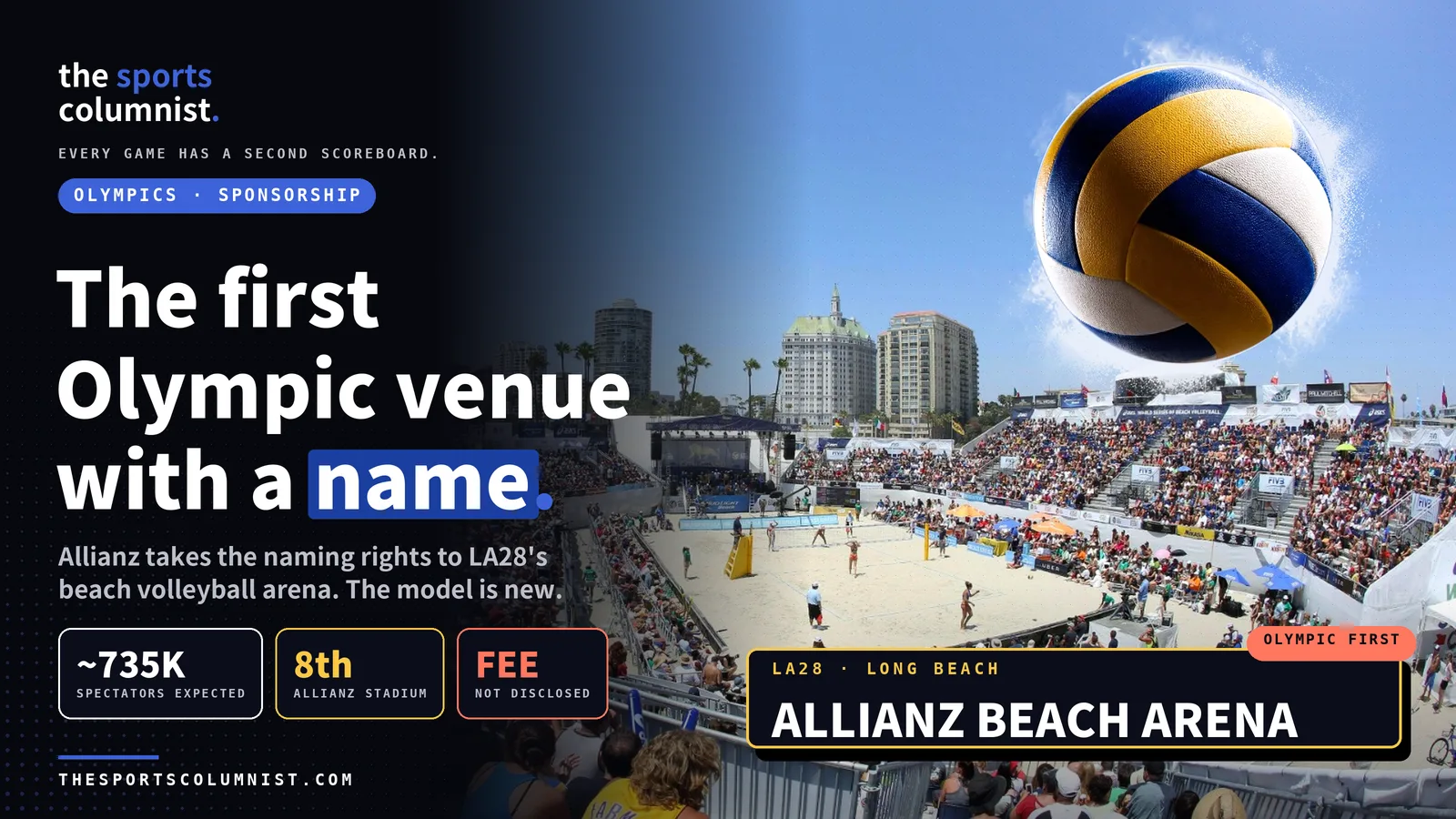
Banner with volleyball arena in the background

Allianz LA28 naming rights have opened a new commercial opportunity in Olympic sponsorship. The insurer has secured naming rights to the beach volleyball arena for the Los Angeles 2028 Olympic and Paralympic Games, becoming the first brand to have its name on an Olympic competition venue.

The temporary waterfront venue in Long Beach, California, will be called the Allianz Beach Arena. It will host Olympic beach volleyball and Paralympic blind football, bringing two of Allianz's major sports partnerships together under one roof: its worldwide Olympic and Paralympic partnership and its global network of branded stadiums.

Announced on 26 October 2026, the agreement is about more than putting a corporate name on a stadium. It reflects a wider change in how LA28 intends to generate commercial value from its venues, with naming rights creating an additional sponsorship opportunity within the Olympic ecosystem.

The financial terms of the Allianz agreement have not been disclosed. But the significance lies in the commercial model it represents.

What Allianz gets from the deal

Allianz has been a Worldwide Olympic Partner since 2021, with its partnership extending through 2032. The company also has an established presence in stadium naming rights, with venues in Germany, England, Australia, France, Austria, Italy and the United States carrying its name.

The Long Beach arena becomes the eighth member of its Allianz Family of Stadiums and the first temporary venue built specifically for an event to join the network.

For Allianz, the agreement creates a direct link between its Olympic partnership and its existing venue portfolio. Rather than relying only on broader Games sponsorship, the insurer can associate its name with a specific competition venue and the experience of fans attending it.

Beach volleyball is particularly suited to this approach. At Paris 2024, the sport drew attention for its setting beneath the Eiffel Tower. At LA28, the waterfront location in Long Beach will provide another distinctive backdrop.

The venue will also host Paralympic blind football, giving the naming rights exposure across both Olympic and Paralympic competitions.

According to Allianz's announcement, the arena is expected to welcome nearly 735,000 spectators across the two competitions. That creates a substantial potential audience for the brand, although actual commercial value will depend on attendance, broadcast exposure and how the partnership is activated.

LA28 is changing the Olympic sponsorship model

For decades, Olympic competition venues have generally used neutral names during the Games, even when they carry commercial names outside the event. The approach has helped protect the Olympic brand and maintain a consistent presentation across venues.

LA28 is taking a different route.

Working with the International Olympic Committee, the organising committee introduced a venue naming-rights programme that allows eligible commercial partners to secure naming rights at selected competition venues. The initiative creates a new sponsorship asset alongside established opportunities such as official partner status, advertising and hospitality.

The Allianz Beach Arena is the latest example of this approach. Other venue arrangements announced for LA28 include the Comcast Squash Center at Universal Studios and the continued use of the Honda Center name for indoor volleyball.

The strategy has a clear commercial logic. The organising committee can offer sponsors a more specific association with a competition location, while partners gain a name that can appear in event communications, venue references and the broader fan experience.

For LA28, naming rights also create another potential revenue stream without requiring every opportunity to take the form of a conventional advertising placement.

However, the model has boundaries. The programme applies to qualifying partners and venues, rather than allowing unrestricted commercial branding across all Olympic sites. The IOC and organisers must still balance sponsorship revenue with the consistency and integrity of the Games.


Why venue naming rights matter to sports business

A naming-rights agreement is not simply a payment for signage. At its strongest, it connects a brand with a place, a competition and an experience that audiences remember.

For Allianz, the Long Beach deal strengthens a portfolio that already includes established stadiums such as Allianz Arena in Munich, Allianz Stadium in Sydney and Allianz Field in Minnesota. Adding an Olympic venue gives the company an association with a global event that reaches beyond the regular audiences of any one club or stadium.

The arrangement also illustrates how brands can build a portfolio of sports assets rather than treating each sponsorship as an isolated campaign. A stadium network can support hospitality, business relationships, community activity and brand storytelling across different markets.

For LA28, the attraction is the opportunity to monetise a temporary venue through a commercial asset that can be sold to an eligible partner. That is particularly relevant for a Games built around a distributed venue plan, using existing facilities alongside temporary structures.

The commercial opportunity is real, but its value cannot be assessed from the venue name alone. Without a disclosed fee, it is not possible to calculate the direct financial contribution of Allianz's agreement or compare its value with other Olympic sponsorship deals.

The question of long-term value

The most important test for LA28 will be whether venue naming rights generate meaningful incremental revenue without creating confusion or weakening the Olympic brand.

A sponsor needs visibility, but that visibility must translate into something more valuable than a name appearing on a venue map. Broadcast references, audience engagement, hospitality and the quality of the on-site experience will all influence the return.

There is also a distinction between commercial reach and commercial value. A venue may welcome hundreds of thousands of spectators, but attendance alone does not establish how much a sponsor has paid or what return it will receive.

The model could become an important part of how future Games structure commercial partnerships. If LA28 demonstrates that venue naming rights can work within Olympic rules while generating additional income, future organisers may have a stronger case for adopting similar arrangements.

But the agreement should be seen as a new commercial experiment, not proof that naming rights will transform Olympic finances.

The question that matters

So here is the question worth asking: can LA28 turn venue naming rights into a repeatable source of commercial value while preserving what makes the Olympic Games distinctive?

Allianz has secured a unique position by becoming the first brand to have its name on an Olympic competition venue. For the insurer, it connects a global sporting partnership with an established stadium strategy. For LA28, it tests whether a venue can become a more flexible commercial asset.

The financial terms remain private, so the deal's immediate monetary value is unknown. Its broader significance, however, is clear: Olympic sponsorship is expanding beyond traditional partner categories into the naming of competition venues.

At The Sports Columnist, we cover the deals, the money and the decisions behind sport. Every game has a second scoreboard, and at LA28, that scoreboard will track how far the Olympic movement can take its new commercial model.

Sources: Allianz's official announcement; International Olympic Committee announcement; LA28's venue information

Read more from The Sports Columnist

comments.

0 comments

No comments yet. Be the first to join the conversation.

read next.

All stories →

The business of sport, every Monday, in five minutes.

The Dugout is our free weekly newsletter: the deals, the money and the decisions, explained.

Join founders, marketers and students across India. No spam, ever.