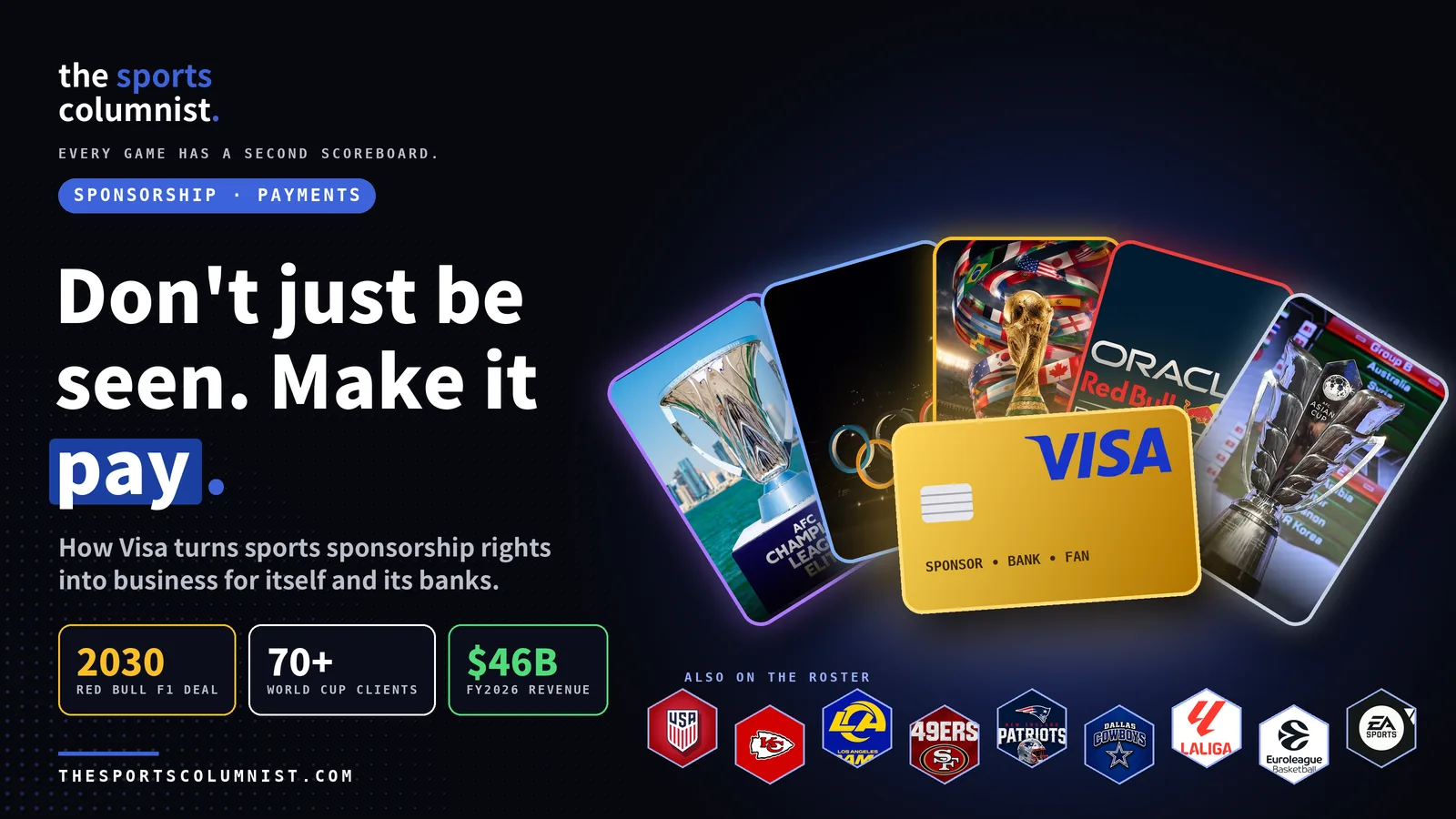
Don't just be seen. Make it pay. Photo: The Sports Columnist
Sponsorship that pays for itself
Most brands buy sports sponsorship to be seen. Visa sports sponsorship works differently: the company buys rights to the world's biggest events, then turns those rights into paid work for the banks that issue its cards.
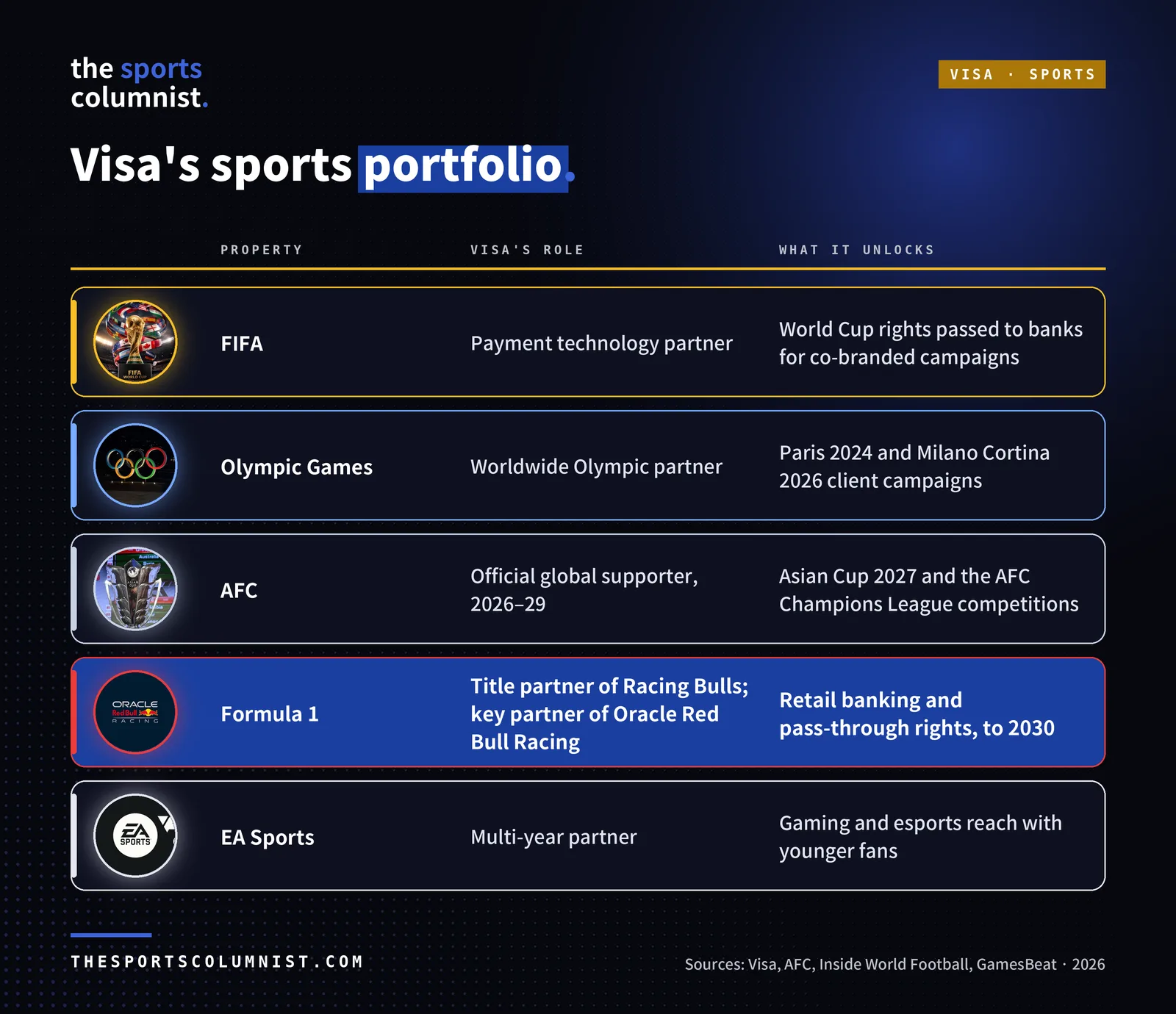
Visa is a worldwide partner of FIFA and the Olympic Games, and title partner of Formula 1's Visa Cash App Racing Bulls. In February 2026 it extended its Red Bull F1 deal through 2030 (Visa).
The results now show up in its accounts. Visa reported record net revenue of $46 billion for fiscal 2026, and management credited "marketing services engagements related to FIFA" as a driver of growth (Visa Q4 FY2026 earnings call).
The question for every sponsor is no longer just how many people see the logo. It is how much business the partnership creates.
The portfolio
Visa does not spread its money thinly. It concentrates on a few global properties that reach almost every market where its cards are used: the World Cup, the Olympics, Formula 1 and, increasingly, Asian football. In October 2026 Visa expanded its AFC deal to cover the Asian Cup 2027 and the AFC's three Champions League competitions for 2026–29 (Inside World Football).
The Red Bull renewal shows how detailed these deals have become. Visa stays title partner of Visa Cash App Racing Bulls, adds front-wing branding on Oracle Red Bull Racing's car, and gains exclusive retail banking category rights and expanded pass-through rights (Visa). "Pass-through" is the key phrase: it means Visa can share the rights with its partners.
How rights become revenue
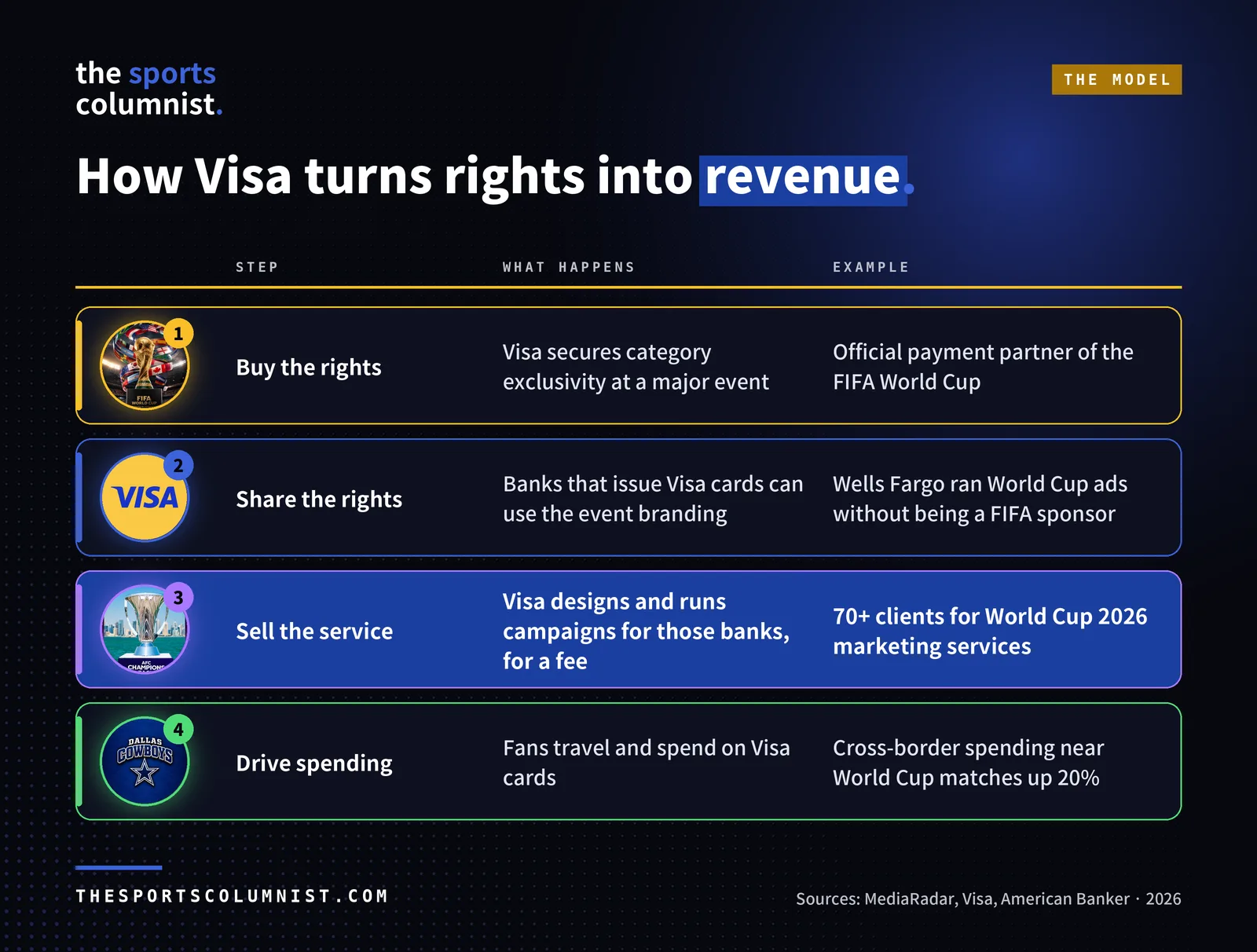
The model has four steps, and the 2026 World Cup shows each one.
Buy the rights. Visa is FIFA's official payment technology partner, with category exclusivity.
Share the rights. Banks that issue Visa cards can use World Cup branding in their own ads. Wells Fargo, which is not a FIFA sponsor, ran six World Cup ad flights worth more than $18 million in tracked media, built on Visa's rights (MediaRadar).
Sell the service. Visa also designs and runs campaigns for those banks, and charges for it. Going into 2026, management said more than 70 clients had signed up for World Cup marketing services and over 35 for the Winter Olympics (Visa Q4 FY2025 earnings call).
Drive spending. During the tournament, cross-border payments in and around match sites rose 20%, and tap-to-pay transactions rose nearly 12% (American Banker).
The Olympics work the same way. According to one widely shared analysis, Visa ran 327 campaigns across 89 markets around Paris 2024, earning more than $100 million in marketing services revenue (365/24/7). Visa has not broken out that figure in its own results, so treat it as an estimate.
Two teams, one grid
In Formula 1, Visa backs two teams owned by the same group: Oracle Red Bull Racing and Visa Cash App Racing Bulls. It also sponsors F1 Academy, the women's series, with two cars on the grid.
The deal is built for banks as much as for fans. Visa holds exclusive retail banking rights with Oracle Red Bull Racing, so a bank that partners with Visa can tie its own cards and offers to one of the sport's biggest teams. The Red Bull Showrun Tour adds cardholder offers, point-of-sale experiences and VIP hospitality in four US cities (Visa).
That is the difference between a logo on a car and a sales platform.
The second scoreboard: what Indian sport can learn
Indian sponsorship is still mostly sold on visibility: jersey space, ground signage and broadcast mentions. Visa's model points to three shifts.
Buy rights you can share. The most valuable rights are the ones a sponsor can pass on to its own partners, such as banks, retailers or distributors. That turns one deal into many campaigns.
Charge for activation, not just the logo. Visa earns twice: once from the spending a campaign drives, and again from the marketing work itself.
Measure business, not reach. Cards issued, transactions and revenue tell a sponsor far more than impressions do.
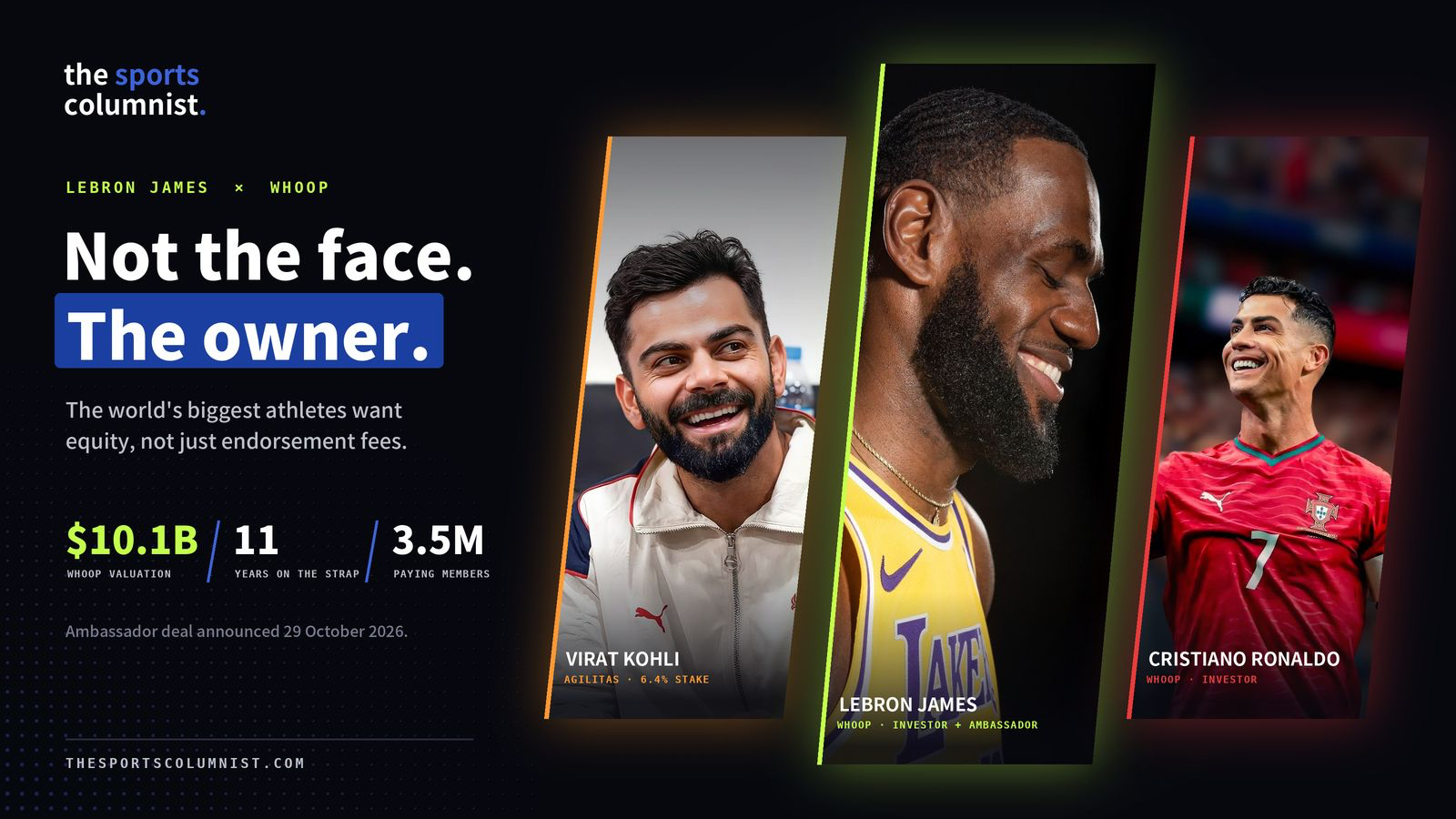
It is the same shift we see with athletes, who are moving from endorsement fees to ownership. We traced that pattern in the billion-dollar club of the highest-paid athletes of all time. Brands are learning the same lesson: the real return comes from what a partnership builds, not what it displays.
The takeaway
Visa does not treat sport as an advertising slot. It treats it as a product it can resell to its partners and turn into spending on its network. The logo is the start of the deal, not the end of it.
At The Sports Columnist, we cover the money, deals and decisions behind sport. Every game has a second scoreboard, and for Visa, it is measured in transactions.
FY2026 revenue and World Cup figures are from Visa's earnings calls and press releases, MediaRadar and American Banker. The Paris 2024 campaign figures are from an independent analysis and have not been confirmed by Visa.
Should Indian sponsors stop buying visibility and start buying rights they can sell on?
comments.
0 commentsNo comments yet. Be the first to join the conversation.