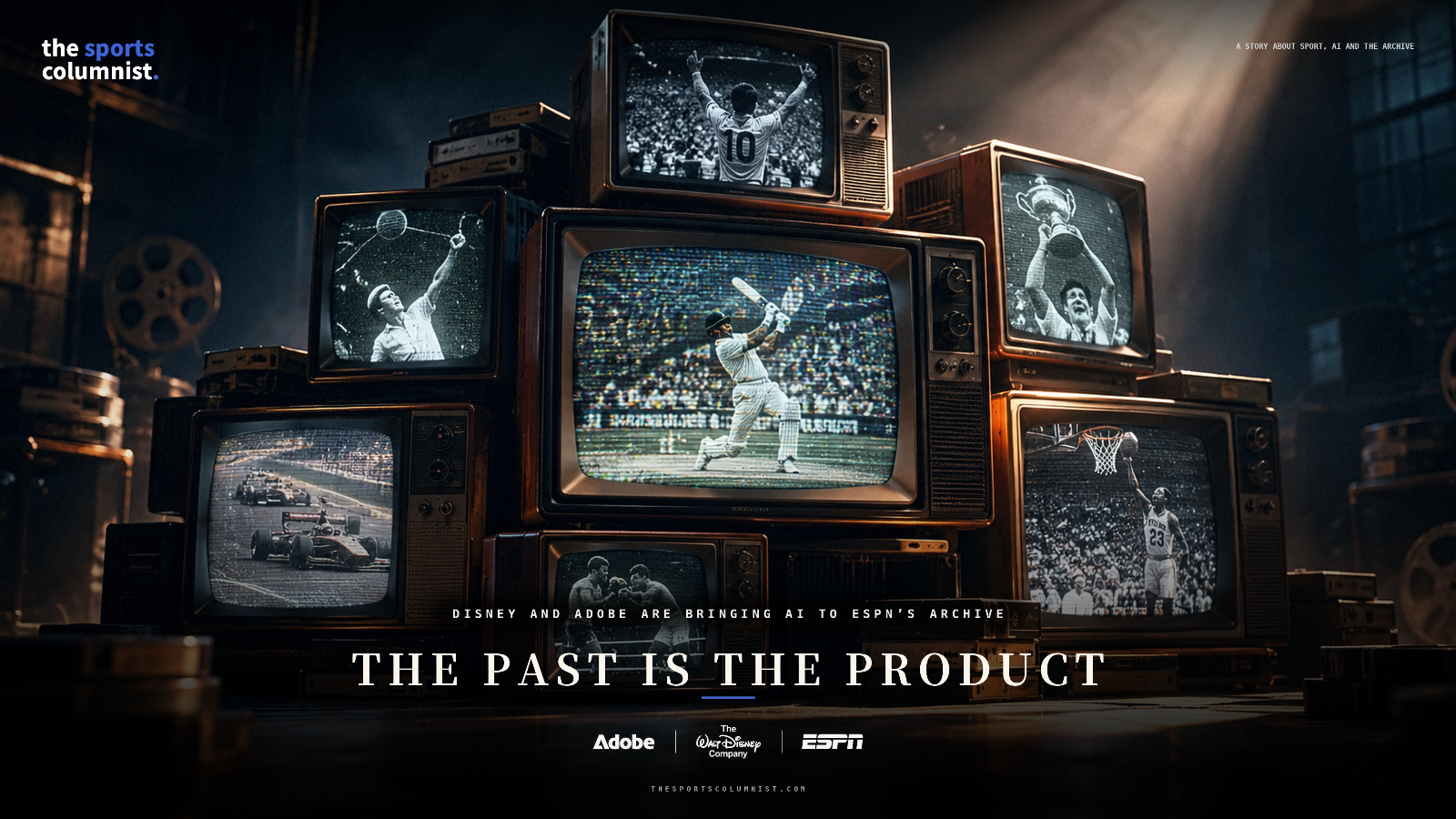
Every sports broadcaster is sitting on decades of footage: famous goals, forgotten interviews, title-winning moments. Most of it sits in vaults, hard to search and rarely seen. Disney’s new AI deal with Adobe suggests that’s about to change. The Disney Adobe ESPN partnership puts a spotlight on one of sport’s most underused assets: its archive.
What happened
Disney and Adobe signed a wide-ranging AI partnership on Monday. The Walt Disney Company and Adobe have expanded their relationship into a multi-year strategic alliance, announced today, November 9, 2026, at Adobe MAX in Miami Beach. As part of it, Adobe becomes an Official AI Innovation Partner of The Walt Disney Company.
Most of the deal is about Disney’s parks, films and characters. At its heart, through Adobe’s Firefly Foundry, which lets enterprises build and deploy custom AI models, the two companies will work on gen-AI models trained on Disney’s intellectual properties that will generate production-ready outputs. The models will be private and proprietary to Disney.
But sport has its own piece. ESPN and Adobe will look at ways AI can improve fan engagement, change how ESPN delivers content and bring ESPN’s archive to life. And it’s already moving: projects involving StudioLab and ESPN Edge are already underway.
The money hasn’t been revealed. The companies have not disclosed the financial value of the multi-year partnership.
Why the archive matters
It’s footage nobody else has. A broadcaster’s archive is a record of decades of sport that can’t be recreated. Every famous moment, interview and highlight is a piece of content that fans still want to see.
But most of it is hard to use. Old footage often isn’t properly tagged or searchable. Finding a specific moment can take hours, which is why so much of it never gets used. In our view, this is where AI changes the economics: tools that can recognise players, moments and context could turn a vault of tape into a library you can search in seconds.
And speed matters. Disney says AI is already transforming how fast it works. “We talk about the time frames in our projects in years — it’s years’ worth of development. And what Adobe Foundry has allowed us to do is compress the creative process that would have taken months to now being able to do that in hours and days,” said Disney’s Kyle Laughlin. Applied to sports content, that could mean finding, editing and packaging archive clips in minutes rather than days.
How an archive can make money
In our view, there are four ways AI could turn sports archives into a commercial asset:
Personalised highlights: clips built around your favourite team, player or rivalry, delivered in an app, and paid for by subscriptions or advertising.
“On this day” and nostalgia content: daily social media posts and short videos built from classic moments, which keep fans engaged between live games.
Licensing to brands and creators: archive clips for ads, documentaries and campaigns, sold faster because they can be found and cleared quickly.
New formats: interactive timelines, career retrospectives and data-driven stories that weren’t practical to produce by hand.
All of this turns a cost (storing old footage) into revenue.
The catches
Who owns the footage? Broadcasters don’t always own the rights to the games they show. Leagues, clubs and governing bodies often control them, so using archive footage in new ways may need fresh agreements.
Players and likeness. Using AI around real athletes, especially to generate new content, raises questions about consent and image rights. The Disney deal’s focus on “private” and “commercially safe” models suggests both companies know this is sensitive territory.
Trust. Sports fans value authenticity. AI that edits or packages real footage is one thing; AI that creates moments that never happened would be very different, and risky for a news brand like ESPN.
Jobs. The deal also lands at a sensitive time: the agreement comes as Disney reportedly considers eliminating thousands of jobs to reduce costs. AI that speeds up editing and production will raise questions about who does that work in future. benzinga
What it means for India
India has one of the richest sports archives in the world, especially in cricket, spread across broadcasters, boards and media groups. In our view, the same opportunity applies here: decades of cricket, hockey and other sports footage could become searchable, shareable and sellable, especially for nostalgia-driven content around big tournaments. The first Indian rights holder to organise its archive with AI could create a genuinely valuable new business.
The question that matters
Is the next great sports asset not a new league or a new team, but the footage of games already played? The Disney and Adobe deal is an early sign that the answer could be yes. The broadcasters that can find, package and sell their past fastest may have one of the most valuable libraries in sport.
At The Sports Columnist, we cover the deals, the money and the decisions behind sport. Every game has a second scoreboard, and some of it is sitting in the archive.
Sources: Disney and Adobe announcement at Adobe MAX, 9 November 2026; reporting by Reuters, Benzinga and others.
Read more from The Sports Columnist
→ Why Dick’s Sporting Goods chose Bengaluru for its AI-native sports-tech centre
→ Sports media mergers: what Paramount and Warner Bros mean for sport
→ Get The Dugout, our free newsletter, every Monday



comments.
0 commentsNo comments yet. Be the first to join the conversation.